
Tel:
+86-551-6346-0808
Factory Add:
Plant 5-6, Zhongnan High Tech Industrial Park, Zhegao, Chaohu City, Anhui. 

Views: 0 Author: Site Editor Publish Time: 2026-03-17 Origin: Site
A well-manufactured Insulation Tube is designed to control heat transfer, reduce condensation, and support stable HVAC performance. However, even the best material cannot compensate for careless installation or poor application decisions. Many insulation-related problems—sweating pipes, unexpected energy loss, premature cracking, or seam separation—do not appear immediately after installation. They develop gradually because certain details were overlooked at the beginning. This article focuses entirely on what you should watch out for when using insulation tube products, helping buyers and installers prevent avoidable mistakes and achieve reliable long-term results.
Insulation works only when it forms a continuous barrier around the pipe. Any interruption weakens the entire system.
Thermal insulation is designed to slow down heat transfer between the pipe surface and surrounding air. When a section of pipe is left exposed—even a small one—that area becomes a direct pathway for heat exchange.
In cooling systems, this leads to warm air contacting cold pipe surfaces, increasing the risk of condensation. In heating systems, exposed sections allow heat to dissipate into the surrounding space, reducing efficiency.
These weak points often become the first places where condensation forms or temperature fluctuations occur. Over time, they can undermine the overall performance of the entire piping network.
Installers often focus on long straight sections because they are easier to handle. However, elbows, tees, valves, and connection points require equal or greater attention.
These areas are more vulnerable to movement, vibration, and mechanical stress. If insulation is loosely fitted around joints, gaps may develop during temperature cycling.
Rubber insulation tube products are particularly helpful in these areas because their flexibility allows tighter coverage around curved surfaces. PE insulation pipe can also be installed effectively if cuts are precise and seams are sealed carefully.
Partial coverage may appear acceptable during installation, but even small exposed segments can create condensation hotspots. A properly installed insulation tube should provide continuous and complete coverage without interruption.
Consistency in wall thickness and inner diameter—such as those offered by LUKWOM insulation products—helps ensure tight alignment and easier sealing.
Condensation is one of the most common reasons insulation fails in practice.
Sweating occurs when the surface temperature of a pipe falls below the dew point of surrounding air. Moisture in the air condenses on the pipe surface.
If insulation thickness is insufficient or seams are poorly sealed, the outer surface of the insulation may also reach dew point temperature, allowing moisture to form externally.
Wrapping a pipe loosely with insulation material does not guarantee condensation control. The insulation must fit tightly and maintain its closed-cell structure to prevent vapor infiltration.
Polyethylene LDPE foam insulation tubes produced by LUKWOM are designed with stable closed-cell composition to reduce moisture penetration. However, performance depends on correct installation and proper sealing.
Persistent condensation can damage ceilings, drywall, insulation boards, and electrical systems. It may also promote mold growth and corrosion of metal components.
Addressing condensation problems after they appear often involves significant repair costs. Preventing them through proper insulation tube application is far more efficient.
Thickness selection is one of the most underestimated factors in insulation performance.
Larger pipes present greater surface area, increasing heat transfer potential. Thin insulation on large-diameter pipes may not provide adequate thermal resistance.
LUKWOM offers insulation tubes with wall thickness options ranging from 5 mm to 25 mm. Matching wall thickness to pipe diameter and operating temperature ensures effective protection.
Humidity level plays a major role in condensation risk. In high-humidity environments, thicker insulation may be required to maintain the outer surface temperature above dew point.
Ambient airflow also influences thermal exchange. Pipes exposed to moving air lose or gain heat faster than those in enclosed spaces.
Even high-quality PE insulation pipe or rubber insulation tube products cannot compensate for insufficient thickness. Under-insulation leads to energy waste and moisture problems, reducing the return on investment.
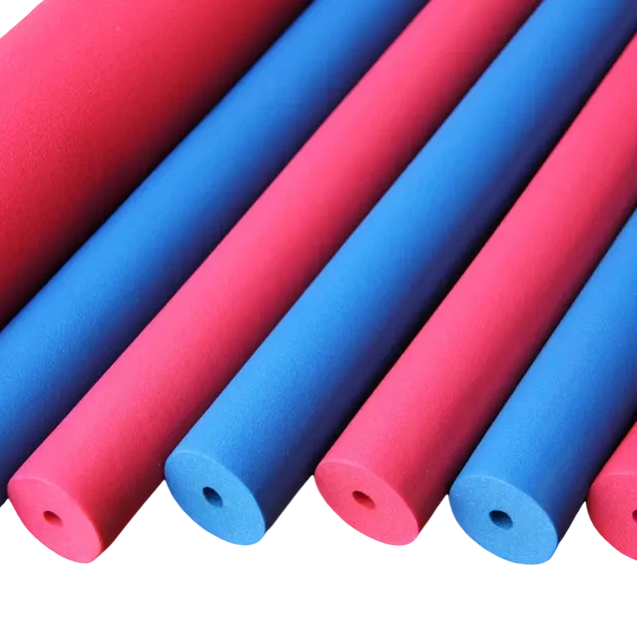
Material choice must align with operating conditions.
PE insulation pipe is widely used in refrigeration equipment, water supply systems, underfloor heating, and solar pipeline insulation. It offers reliable thermal resistance for moderate temperature ranges and is easy to handle.
Its lightweight structure simplifies installation, especially in residential and light commercial HVAC systems.
Rubber insulation tube products are often preferred for chilled water systems or installations requiring high flexibility. Their elasticity improves performance in tight routing and frequent temperature cycling.
Selecting insulation based solely on availability rather than performance requirements can result in cracking, deformation, or moisture infiltration. Evaluating temperature range, humidity exposure, and installation layout before choosing the material reduces long-term maintenance risk.
Installation precision significantly influences insulation effectiveness.
Accurate cutting ensures that insulation sections align closely. Jagged or uneven cuts create visible gaps and reduce surface coverage.
After fitting insulation, seams must be closed securely. In cold-line systems, even small openings can allow humid air to penetrate and contact the pipe surface.
Loose seams compromise the integrity of the insulation barrier. Over time, vibration and temperature cycling may widen these gaps.
LUKWOM insulation tubes are manufactured with consistent dimensional tolerances, supporting easier seam alignment and more reliable closure.
Installation is only the beginning of insulation performance.
Outdoor installations expose insulation to sunlight, temperature fluctuations, and weather changes. Materials must withstand environmental stress without degrading.
Repeated handling or mechanical contact may compress insulation material. Durable foam structure reduces the risk of surface damage.
Even properly installed insulation may eventually require inspection or maintenance. Planning for long-term exposure conditions helps prevent unexpected failure.
Improper storage may compress or deform insulation tubes. Keep materials in dry, clean environments before installation.
Excessive tightening may reduce foam cell integrity and decrease insulation effectiveness.
An insulation tube with incorrect inner diameter may leave gaps or require excessive stretching, both of which reduce performance.
Mistake | What Happens | How to Prevent It | Product/Form Note |
Leaving exposed pipe sections | Heat loss or condensation hotspots | Ensure complete and continuous coverage | Use correct inner diameter |
Poor joint sealing | Moisture infiltration | Seal seams tightly and consistently | Closed-cell PE insulation pipe helpful |
Insufficient thickness | Reduced thermal resistance | Match thickness to pipe size and temperature | Choose appropriate wall thickness |
Ignoring humidity conditions | Increased sweating risk | Consider ambient moisture before selection | Rubber insulation tube may offer advantage |
Incorrect material for application | Premature cracking or deformation | Evaluate system temperature and layout | Select PE or rubber accordingly |
Improper storage before installation | Deformation or surface damage | Store in dry and protected conditions | Protect foam integrity |
Most performance problems associated with insulation tube products are preventable. Paying attention to full coverage, correct thickness, proper material selection, seam sealing, and long-term exposure conditions ensures stable and reliable results. LUKWOM manufactures polyethylene LDPE foam insulation tubes for refrigeration equipment, water supply and drainage systems, underfloor heating, and solar energy pipeline insulation, with ISO9001-certified production and RoHS-compliant materials. When applied correctly, our insulation solutions provide dependable pipe insulation performance across diverse HVAC environments. Contact us to learn more about our product specifications and how to support your insulation project effectively.
Sweating often results from gaps, insufficient thickness, or poor seam sealing rather than material quality.
It can be suitable under moderate conditions, but high-humidity environments may require careful thickness selection or flexible rubber insulation tube.
Seam sealing is critical in cold-line systems because small openings allow humid air to contact the pipe surface.
Yes, improper cutting, compression, or environmental exposure can shorten insulation durability even if the material itself is high quality.


