
Tel:
+86-551-6346-0808
Factory Add:
Plant 5-6, Zhongnan High Tech Industrial Park, Zhegao, Chaohu City, Anhui. 

Views: 0 Author: Site Editor Publish Time: 2026-07-18 Origin: Site
Choosing proper mounting solutions for outdoor condenser units is vital. They need to withstand harsh environments, while preserving building appearance and structure. Ordinary powder-coated brackets tend to rust, causing wall stains, reduced load capacity and even equipment collapse. Ground-mounted units face risks of flood, snow and flying debris. This guide analyzes practical mounting plans, helping you make cost-effective and safe choices for long-term use.
Corrosion-resistant materials bring long-term returns: Stainless steel avoids rust stains and structural damage.
High-gauge stainless steel delivers stable load capacity and resists metal fatigue from compressor vibration.
Wall mounting elevates units above flood, snow and debris, extending equipment service life.
Premium brackets comply with building codes on wind resistance and weight limits, fitting 9,000 to 36,000 BTU units.
Wall brackets save ground space and deter theft effectively, ideal for areas with limited yard space or heavy foot traffic.
Concrete pads may tilt due to soil settlement or frost heave, unbalancing compressors and wearing internal bearings. Ground units are also vulnerable to snow blockage and coil damage from flying debris.
Wall mounts transfer vibration to buildings, but this issue can be solved by equipping thick rubber vibration dampers to eliminate indoor noise.
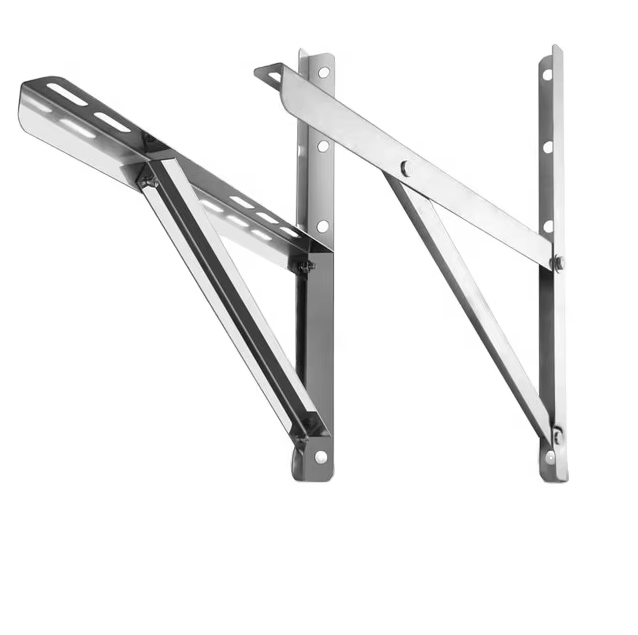
Scratches during installation peel off the coating and trigger rust. Rust will leave stubborn orange stains on exterior walls and weaken brackets gradually. Low upfront cost leads to frequent replacement and extra wall repair expenses.
Stainless steel forms a protective chromium oxide layer against moisture, and the layer can self-repair after scratches.
304 Stainless Steel: Suitable for general outdoor areas with rain and snow, service life over 15 years.
316 Marine Grade Stainless Steel: Added molybdenum, perfect for coastal salt-laden air and industrial zones, service life over 25 years.
Material Type | Rust Resistance | Ideal Environment | Longevity |
|---|---|---|---|
Powder-Coated Mild Steel | Low | Dry, indoor or highly sheltered | 2 - 5 years |
304 Stainless Steel | High | Standard outdoor, rain, snow | 15+ years |
316 Marine Grade Stainless | Extreme | Coastal, heavy salt, industrial | 25+ years |
Load capacity: Select brackets rated for at least 50% higher weight than the unit’s dry weight, to bear dynamic operating stress.
Unit Size (BTU) | Average Unit Weight | Minimum Bracket Rating |
|---|---|---|
9,000 - 12,000 BTU | 60 - 90 lbs | 150+ lbs |
18,000 - 24,000 BTU | 100 - 150 lbs | 250+ lbs |
30,000 - 36,000 BTU | 160 - 220 lbs | 350+ lbs |
Vibration isolation: Equipped with high-density rubber pads to prevent fasteners from loosening.
Structure design: Choose 11-gauge or 14-gauge thick steel for rigidity, and adjustable crossbars to fit different unit sizes.
Check wall structure before installation: Use masonry expansion bolts for brick/concrete walls, and lag screws fixed into wooden studs for wood-framed walls. Never fix brackets only on plywood or vinyl siding.
Reserve sufficient airflow clearance as required by manufacturers; insufficient gap will cause overheating and void the warranty.
Do not place condensers on window sills. Window frames cannot bear dynamic loads, which may lead to structural damage and broken glass.
Assess environment: Pick 316 stainless steel for coastal regions, 304 for inland areas.
Check load rating: Match bracket capacity with unit weight and reserve a 50% safety margin.
Inspect full kit: Confirm complete accessories including corrosion-resistant bolts and rubber isolators.
High-quality stainless steel brackets are a reliable investment. They protect condensers from ground hazards and keep building exteriors intact. Do not prioritize low-cost mild steel, as its failure will cause greater losses. Verify unit specs and consult local technicians to meet building codes before purchase.
A: Yes. Humidity, rain and condensation will rust ordinary steel, resulting in structural risks and wall stains.
A: Proper installation with rubber dampers and firm fixation will avoid vibration and wall damage.
A: Wall brackets are preferred, as long as the wall can bear the load and vibration dampeners are installed.
A: Premium stainless brackets generally hold 250–400 lbs, compatible with most 9,000–36,000 BTU residential units. Always check official parameters.


