
Tel:
+86-551-6346-0808
Factory Add:
Plant 5-6, Zhongnan High Tech Industrial Park, Zhegao, Chaohu City, Anhui. 

Views: 0 Author: Site Editor Publish Time: 2026-08-11 Origin: Site
Degraded or improper refrigerant line insulation forces HVAC compressors to work harder. It accelerates equipment wear and risks severe property damage through uncontrolled condensation. Whether specifying materials for a commercial build or replacing weathered foam on a residential heat pump, selecting the right Thermal Insulation Tube requires strict attention to detail. You must balance material durability, thermal resistance (R-value), and environmental exposure. Poor choices lead directly to energy waste and sweating pipes.
This guide provides a purely objective, spec-driven framework. We will help you evaluate and select the correct insulation materials. You can secure reliable system performance without overpaying or compromising local building compliance. By understanding material limits and proper sizing, you ensure a highly efficient, long-lasting installation.
Prioritize closed-cell structures (like elastomeric rubber or high-density PE insulation pipe) to ensure an effective vapor barrier and prevent moisture ingress.
Verify exact Inner Diameter (ID) and Wall Thickness to meet local building codes (e.g., IECC requirements for R-value) and ensure flush pipe fit.
Match the material to the environment: outdoor applications mandate high UV resistance or secondary jacketing to prevent premature degradation.
Avoid standard retail "big box" plumbing foam; specify HVAC-rated materials designed for the extreme temperature fluctuations of refrigerant lines.
Uninsulated or poorly insulated suction lines absorb ambient heat rapidly. We call these the vapor lines. When they absorb heat, your cooling capacity drops significantly. This temperature differential also creates severe condensation. We often refer to this as pipe sweating. Dripping water quickly damages surrounding building materials like drywall, framing, and drop ceilings. Purpose-built refrigerant line insulation acts as your primary defense against these structural risks.
Heat pumps present unique thermal challenges. During heating mode, the hot gas line carries essential heat from the outdoor compressor. Effective pipe heat loss prevention on this specific line is critical. It maintains thermal delivery directly to the indoor coil. If heat escapes into the cold outdoor air, your indoor vents blow lukewarm air. You lose comfort and waste significant electricity.
Failing to replace cracked or missing HVAC foam leads to measurable efficiency drops. Your system loses its thermal boundary. Consequently, compressors overexert themselves continuously to meet indoor thermostat demands. This relentless overexertion shortens equipment lifespan drastically. While upgrading your insulation will not miraculously fix a failing compressor, it remains a fundamental prerequisite. You absolutely need it for baseline system performance and strict code compliance.
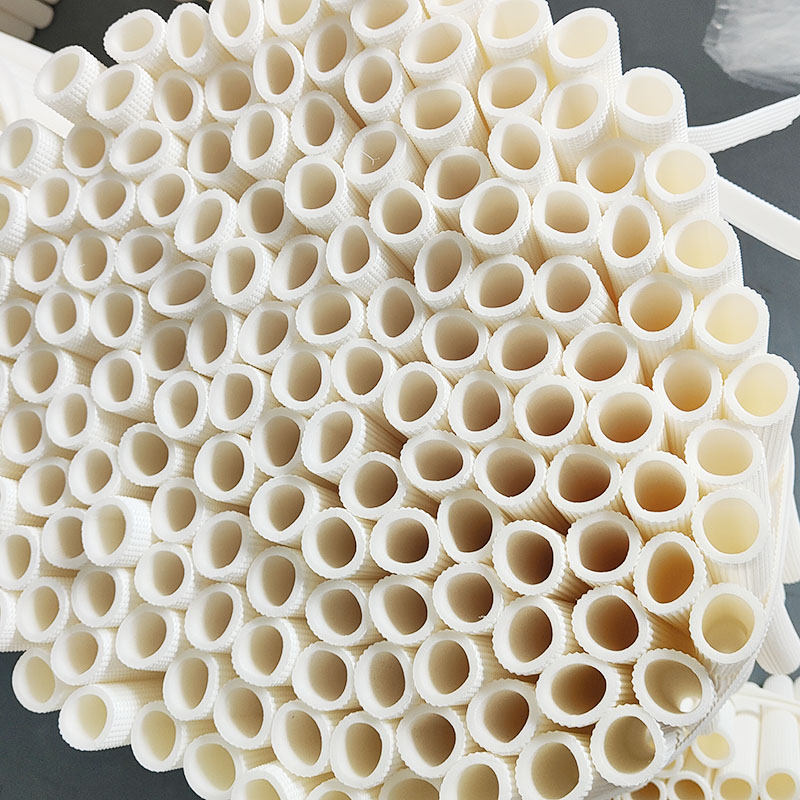
Professionals choose insulation based on cellular structure and thermal stability. Open-cell foam acts like a sponge. It absorbs moisture over time. Closed-cell foam blocks moisture transmission entirely. We must evaluate the two dominant closed-cell materials used today.
Elastomeric rubber serves as the undisputed industry standard for commercial and professional applications. It is highly flexible. Installers easily bend it around complex pipe joints. It inherently resists moisture transmission, providing an excellent vapor barrier. Furthermore, it boasts exceptional thermal conductivity ratings. However, it has drawbacks. Bare elastomeric rubber degrades under direct sunlight. It requires UV-protective coatings outdoors. It also carries a higher upfront cost.
Manufacturers produce PE insulation pipe as a cost-effective, durable alternative. It frequently arrives pre-slit. It often includes a self-sealing adhesive strip. This feature saves significant installation time. PE materials highly resist physical abrasion and impact. However, consumer-grade variants often lack the high density required for severe temperature swings. Its rigid structure also makes tight, 90-degree bends difficult without cutting and mitering the joints.
We see a massive disparity between retail hardware store foam and wholesale supply materials. Big-box stores usually sell standard plumbing foam. This foam is often open-cell and low density. It is meant for moderate indoor water pipes. Pro-grade supply houses stock materials engineered specifically for HVAC refrigerants. Professional materials handle extreme temperature extremes without melting or shrinking.
Material Feature | Elastomeric Rubber (Pro) | High-Density PE (Pro) | Retail Plumbing Foam |
|---|---|---|---|
Cell Structure | Strictly Closed-Cell | Strictly Closed-Cell | Often Open-Cell / Mixed |
Flexibility | Excellent | Moderate to Stiff | High |
Temp Rating Limit | Up to 220°F (104°C) | Up to 200°F (93°C) | Usually < 160°F (71°C) |
Vapor Barrier Integrity | Premium | Very Good | Poor |
Selecting the correct size is just as important as choosing the right material. Insulation works by trapping microscopic pockets of air within its structure. It does not work by trapping large pockets of air between the foam and the pipe. You must follow strict sizing guidelines.
Your HVAC insulation tube must fit snugly over the copper line. HVAC copper pipes use Outside Diameter (OD) measurements. Therefore, a 7/8-inch copper pipe requires a tube with exactly a 7/8-inch Inner Diameter (ID). Oversized tubes leave gaps. These gaps allow air pockets to form. Condensation breeds inside these air pockets. Water then becomes trapped against the copper pipe, defeating the vapor barrier entirely.
Wall thickness directly dictates the thermal resistance, known as R-value. Common market thicknesses include 3/8", 1/2", 3/4", and 1". Thicker walls yield higher R-values. You should select thickness based on precise local building codes.
Check Local Jurisdiction: Building codes vary by region. Verify exact requirements before purchasing.
Consult IECC Standards: The International Energy Conservation Code (IECC) often mandates minimum R-values.
Unconditioned Spaces: Running lines through attics or crawlspaces typically requires R-4 or higher. This often translates to 3/4-inch or 1-inch wall thickness.
Conditioned Spaces: Indoor runs may only require 3/8-inch or 1/2-inch thickness for basic condensation control.
Refrigerant lines experience wild temperature shifts. Standard water pipes do not. Heat pump discharge lines carry highly pressurized, superheated gas. These lines easily exceed 200°F (93°C) during winter heating cycles. Standard retail foam melts at these temperatures. Ensure your chosen material explicitly rates for these extreme thermal loads.
Outdoor installations face brutal environmental conditions. Professional installers must anticipate sun exposure, weather changes, and local wildlife. You cannot leave bare foam defenseless on a rooftop or side yard.
Bare foam exposed to direct sunlight suffers from severe photo-oxidation. UV rays break down the molecular bonds in the rubber or plastic. The material turns brittle rapidly. It then cracks, shrinks, and disintegrates into dust within a few short years. You lose all thermal protection once the copper pipe sees the sun.
Some premium materials feature built-in UV inhibitors. Always evaluate materials by reading their technical data sheets. Look for products explicitly stating UV-resistant properties. However, real-world experience shows even "UV-resistant" foam eventually degrades without physical shielding. We view built-in resistance as a secondary backup rather than a primary defense.
For rooftop or highly exposed installations, bare foam is never enough. You must factor in the cost of secondary protection. We call this jacketing. Proper jacketing ensures a 10-to-15-year lifespan.
PVC Jacketing: Offers an excellent, clean finish. It snaps over the foam and welds shut. It thoroughly blocks UV rays and rain.
Aluminum Cladding: Provides industrial-grade protection. It deflects heat and withstands severe physical impacts.
UV-Protective Liquid Coatings: Installers brush or spray these specialty paints onto elastomeric foam. You must reapply them every few years.
In certain environments, standard foam attracts local wildlife. Birds tear away soft rubber chunks for nesting materials. Rodents chew through insulation to reach warmth. If you install equipment in rural areas or heavily wooded suburbs, hard-shell jacketing becomes a necessary, immediate upgrade. Bare foam cannot survive persistent pest attacks.
Choosing a great material only solves half the problem. Poor installation ruins the best insulation. You must understand how the physical design of the tube affects labor and long-term reliability.
Manufacturers produce tubes in two main configurations. Each serves a specific installation scenario.
Un-slit Tubes: These are seamless cylinders. They are best for brand-new line sets. Installers slide them seamlessly over the copper piping before flaring or brazing the connections. Because they lack a seam, they provide the ultimate, fail-proof vapor barrier.
Pre-slit Tubes: These feature a lateral cut down the entire length. They are absolutely necessary for retrofits or replacing damaged foam. Look for factory-applied pressure-sensitive adhesive (PSA) seams. You peel away a release liner and press the edges together. PSA seams minimize manual labor and drastically reduce gluing errors.
Your insulated system is only as good as its weakest seam. Water vapor actively seeks out tiny gaps. You must factor in the required adhesives or specialized HVAC tapes. Use professional-grade contact cement designed for elastomeric rubber. Alternatively, use foam tapes approved by the manufacturer. Never use standard silver duct tape. Duct tape adhesive degrades rapidly outdoors and flakes away in the sun.
Homeowners frequently ask if both copper lines require insulation. The larger suction line always requires thick insulation. It carries cold, low-pressure vapor back to the compressor. Without insulation, it sweats profusely and loses cooling capacity.
Whether the smaller liquid line needs insulation depends entirely on the system type. Traditional unitary central AC systems usually leave the small liquid line bare. It carries warm liquid, and ambient heat loss actually helps slightly. However, ductless mini-splits and advanced heat pumps use different expansion valve locations. These systems push cold, low-pressure refrigerant through both lines during operation. Therefore, mini-split configurations strictly require insulation on both lines. Always defer to the specific manufacturer specifications.
Choosing the right insulation for your refrigerant lines requires moving beyond upfront price tags. You must evaluate the closed-cell integrity of the material to ensure an impenetrable vapor barrier. You must verify exact sizing to prevent internal air pockets. Finally, you must demand robust UV durability and jacketing for any outdoor exposure.
Take immediate action to protect your system. Audit your current or planned line runs. Grab a caliper or measuring tape and find the exact outer diameter of your copper pipes. Check your local building codes for minimum R-value mandates. Most importantly, skip the retail hardware aisles. Source pro-grade elastomeric or high-density PE materials from reputable HVAC suppliers to ensure long-lasting efficiency and safety.
A: It depends on the system. Ductless mini-splits typically require both lines to be insulated. Traditional unitary ACs usually only require insulation on the larger suction line. Always defer to the manufacturer's installation manual.
A: It is highly discouraged. Standard plumbing foam is often not rated for the extreme temperature ranges of refrigerant lines, lacks adequate UV protection, and may not meet the R-value required by HVAC building codes.
A: High-quality, properly jacketed insulation can last the life of the system (10-15 years). However, unjacketed foam exposed to direct weather may degrade in 3-5 years and should be replaced as soon as cracking or shrinking exposes the copper pipe.
A: Elastomeric rubber is highly flexible and offers premium condensation control, making it a professional standard. PE (Polyethylene) is stiffer and more durable against physical impact but must be specifically rated for HVAC use to handle extreme temperature fluctuations.


