
Tel:
+86-551-6346-0808
Factory Add:
Plant 5-6, Zhongnan High Tech Industrial Park, Zhegao, Chaohu City, Anhui. 

Views: 0 Author: Site Editor Publish Time: 2026-08-18 Origin: Site
Selecting the right line set is the most critical variable in a split system's lifespan. Poorly chosen piping leads to micro-leaks. It causes severe thermal loss. It often triggers premature compressor failure. Buyers must understand this vital context. Sourcing components for commercial projects or residential upgrades demands strict oversight. The physical quality of the copper directly dictates system efficiency. The integrity of the factory-applied insulation is equally vital for longevity. Failing to vet these materials rigorously guarantees expensive structural repairs later. Substandard parts simply cannot handle modern operational pressures. This guide breaks down the technical criteria for evaluating and purchasing Pre-Insulated Copper Pipe. You will learn how to ensure strict system compatibility. We cover essential compliance standards. We also detail actionable steps to guarantee long-term performance without sacrificing safety.
Sizing is Non-Negotiable: Using existing, undersized piping (e.g., 3/8" instead of 5/8") reduces cooling capacity and risks compressor burnout.
Insulation Specs Matter: True weather-resistant insulation prevents condensation buildup and mitigates thermal loss across both high and low-pressure lines.
System Compatibility: Modern refrigerants (like R-410A and R-32) operate at higher pressures, requiring thicker copper walls and strict vacuum protocols.
Installation Viability: Pre-flared ends save labor time, but extending lines beyond factory pre-charged limits requires precise refrigerant calculations (oz/ft).
Line set failures heavily impact daily operational costs. They also lead to instantly rejected warranty claims. Installing an inferior AC installation pipe causes immediate efficiency drops. You face cascading mechanical failures over time.
Let us explore condensation and water damage first. Inferior insulation allows the cold suction line to sweat constantly. Moisture accumulates rapidly in high-humidity environments. This water drips inside wall cavities completely unnoticed. Over several months, it causes severe structural water damage. You then face expensive mold remediation efforts. Ruined drywall requires immediate replacement.
Thermal loss is another major operational issue. Inadequate insulation thickness forces the compressor to work harder. The refrigerant absorbs ambient heat before reaching the outdoor condenser. This degrades Seasonal Energy Efficiency Ratio (SEER) ratings dramatically. Your energy bills spike as the unit runs much longer cycles. The system struggles to satisfy the thermostat.
Many installers attempt to reuse old R-22 piping. This introduces massive risks for new R-410A or R-32 systems. Old pipes hide mineral oil residue inside the walls. This old residue cross-contaminates modern synthetic POE oils. The chemical reaction creates sludge. Furthermore, older pipes lack the wall thickness required today. They become dangerous pressure vulnerabilities waiting to rupture.
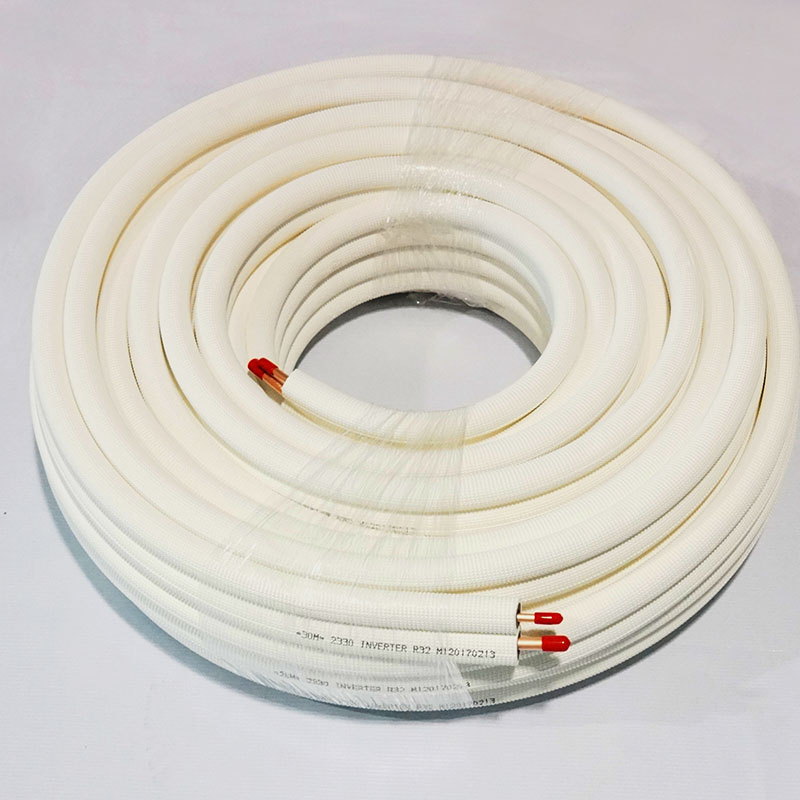
Evaluating material quality prevents catastrophic installation failures. Copper purity and grade represent your very first checkpoints. You must evaluate ASTM B280 compliance carefully. This standard ensures the seamless copper tube suits air conditioning applications. It guarantees the metal resists internal scaling. It also ensures proper annealing for safe bending.
Wall thickness requirements depend entirely on the chosen refrigerant. You must match the thickness to high-pressure modern refrigerants. R-32 operates at significantly higher pressures than legacy gases. Thin-walled budget pipes simply cannot handle this sustained stress. They frequently kink during tight installation bends. A kinked pipe restricts refrigerant flow permanently. You must replace the entire line set if this happens.
Buyers must also assess flared versus non-flared ends. Pre-flared kits save substantial on-site labor time. They reduce the risk of poorly seated connections. Factory flares usually offer superior uniformity. Bulk coils require on-site flaring and deburring. This demands highly skilled labor. Poorly deburred edges cause micro-leaks at the brass nut.
Check the hardware inclusions carefully before purchasing. A complete kit should include necessary brass nuts. It needs properly sized drain hoses. It must also provide UV-resistant wrapping tape. Missing hardware delays installation projects significantly. It forces technicians to use mismatched, subpar components.
Proper sizing determines whether a system cools effectively. The tonnage-to-diameter ratio guides this entire process. Standard sizing matrices pair specific liquid and suction lines. The liquid line pushes high-pressure liquid to the indoor unit. The suction line pulls low-pressure gas back outside. The liquid line is typically 1/4 inch. The suction line varies between 3/8, 1/2, or 5/8 inch. This depends entirely on the BTU or tonnage rating.
System Capacity (BTU / Tons) | Liquid Line Diameter (Inches) | Suction Line Diameter (Inches) |
|---|---|---|
12,000 - 18,000 BTU (1.0 - 1.5 Ton) | 1/4" | 3/8" |
24,000 - 30,000 BTU (2.0 - 2.5 Ton) | 1/4" | 1/2" |
36,000 - 48,000 BTU (3.0 - 4.0 Ton) | 3/8" | 5/8" or 3/4" |
Mismatched diameters introduce severe mechanical risks. An oversized suction line reduces refrigerant gas velocity. The system relies on this velocity to push oil back. If velocity drops, oil return failure occurs. The compressor then suffers from rapid lubrication starvation. It grinds its internal bearings to dust. An undersized line restricts flow completely. It starves the evaporator coil. Both scenarios quickly destroy the compressor.
Furthermore, unapproved line sizes instantly void manufacturer warranties. Brands refuse to cover failures caused by incorrect piping. Installers must always verify the specific AC unit's manual. Never rely on generic industry measurements. Specific engineering parameters dictate system longevity. Always match the exact fractional dimensions using a high-quality split AC copper pipe.
The physical casing around the pipe dictates thermal efficiency. First, check the material composition. You typically choose between cross-linked polyethylene (PE) foam and elastomeric rubber. PE foam features a rigid closed-cell structure. It resists tearing nicely during rough installation through walls. Elastomeric rubber offers superior flexibility for tight corners.
Condensation prevention relies on insulation density and wall thickness. Most residential applications require 3/8-inch to 1/2-inch thickness. This stops the cold suction line from sweating continuously. High-humidity environments demand much denser foam structures. You must look closely at the perm rating. If the foam lacks density, moisture permeates the barrier.
Fire and safety ratings are vital for legal compliance. You must check for fire-retardant certifications aggressively. Look for ASTM E84 compliance on the spec sheet. Commercial building codes strictly require these specific ratings. They limit the flame spread index. This prevents the insulation from spreading fires through wall cavities.
Finally, assess UV and weather resistance capabilities. Exposed outdoor insulation degrades rapidly under direct sunlight. The foam cracks, shrinks, and flakes away within months. This exposes the bare copper to ambient summer heat. You must use protective UV jacketing. Wrapping the exterior lines prevents this costly, ugly degradation on any insulated copper pipe for AC.
Installing a pre insulated copper tube requires strict adherence to factory limits. Factory pre-charged condensers support specific maximum distance limitations. This line length usually spans 15 to 25 feet. Extending beyond this precise limit changes the system's internal pressure dynamics. The factory charge simply cannot fill a longer pipe.
Adding refrigerant becomes legally mandatory for longer runs. Installers follow a strict mathematical calculation rule. You must add a specific amount of refrigerant per additional foot. The installation manual often specifies adding 0.2 to 0.6 ounces per foot. Guessing this exact amount causes severe undercharging or overcharging. Both kill the compressor eventually.
Vacuuming and purging remain non-negotiable, mandatory steps. Even "pre-gassed" systems demand rigorous vacuum protocols. You must pull a deep vacuum on the new line set. Use a digital micron gauge to verify the seal. Technicians usually aim for 500 microns. This removes moisture and harmful non-condensable gases. Skipping this step introduces acid into the compressor oil.
Avoid these common and expensive installation pitfalls:
Bending without a proper mandrel: Hand-bending tight corners creates permanent kinks. This restricts fluid flow severely.
Stripping insulation improperly: Pulling foam too far back at the flare nut exposes bare copper. This causes dripping condensation onto the floor.
Ignoring exact torque specs: Failing to torque brass fittings to specification causes slow micro-leaks. These leaks remain untraceable for months.
Choosing the right manufacturing supplier guarantees material consistency. Quality control prevents headaches during large commercial installations. Follow this strict procurement checklist before signing contracts.
Verify Global Certifications: Look for ISO, CE, or UL marks directly on the spec sheet. These prove baseline manufacturing standards.
Assess Packaging Integrity: Ensure bulk coils arrive fully sealed with heavy-duty end caps. This prevents internal copper oxidation. It stops moisture ingress during overseas shipping.
Review Warranty and Support: Assess the supplier's exact defect replacement policy. You need coverage for manufacturing flaws before installing the pipes behind drywall.
Execute Next Steps: Request detailed technical data sheets (TDS). Verify minimum order quantities (MOQs). Confirm specific installation kit availability.
You need a reliable partner who understands rigorous HVAC demands. A robust data sheet proves their thorough product testing methods. Transparent warranty policies protect your critical project timeline. Do not accept vague specifications.
Sourcing the correct piping requires balancing several critical technical factors. You must ensure strict dimensional matching to the condenser. You need high-grade, weather-resistant insulation to prevent thermal loss. You also require pressure-rated, pure copper to handle modern refrigerants safely. These physical elements work together seamlessly. They maintain peak system efficiency over decades.
Always prioritize exact manufacturer specifications over minor cost-cutting measures. Thin copper tubing saves a few dollars today. However, it causes massive, catastrophic compressor failures tomorrow. A reliable, well-insulated line set protects the multi-thousand-dollar investment of the AC hardware itself. Make your purchasing decisions based on verifiable data. Follow strict industry standards to ensure absolute success.
A: No. Undersizing the suction line restricts refrigerant flow, severely drops cooling capacity, and will likely cause premature compressor failure.
A: Highly recommended. Transitioning between refrigerant types (e.g., R-22 to R-410A) or using lines with questionable structural integrity risks system contamination and leaks.
A: Yes. While the larger suction line is prone to sweating, insulating both lines maximizes thermal efficiency and is required by modern building codes for heat pumps and mini-splits.
A: Yes, if the total length exceeds the manufacturer's pre-charged limit. You must calculate the additional charge based on the specific ounces-per-foot metric provided in the AC manual.


