
Tel:
+86-551-6346-0808
Factory Add:
Plant 5-6, Zhongnan High Tech Industrial Park, Zhegao, Chaohu City, Anhui.


Views: 0 Author: Site Editor Publish Time: 2026-11-10 Origin: Site
Commercial cold storage facilities face a relentless battle against energy loss and aggressive pipe condensation. When refrigeration piping is left exposed or improperly wrapped, system inefficiency is just the beginning. Facility managers often wake up to severe ice buildup, compromised structural supports, and costly maintenance downtime. Cold storage rooms operate in unforgiving environments characterized by extreme sub-zero temperatures and wild humidity fluctuations. Under these demanding conditions, traditional thermal barriers deteriorate rapidly.
This is precisely where the Rubber Insulation Tube has cemented its position as the industry standard for low-temperature piping networks. In this comprehensive guide, we will help facility operators, contractors, and global B2B procurement teams navigate the complex market. We explore the most reliable flexible closed cell options, compare competing materials, determine precise custom sizing, and outline smart global sourcing strategies.
Recent market analyses indicate a massive shift in the commercial refrigeration sector. Driven by stringent global energy efficiency mandates and the rapid expansion of cold chain logistics, facility managers are actively moving away from legacy rigid foams. The current industry trend leans heavily toward advanced elastomeric solutions. These modern materials offer rapid deployment, a lower lifecycle carbon footprint, and fail-safe moisture control in extreme environments. Engineers are prioritizing insulation that not only meets current building codes but anticipates stricter future energy regulations.
Superior Moisture Control: Flexible closed cell elastomeric tubes naturally repel water vapor, making them the ultimate engineering choice for preventing condensation on sub-zero pipes.
Energy Efficiency: High-quality foam materials feature exceptionally low thermal conductivity, significantly reducing the operational energy costs required to maintain deep-freeze temperatures.
Customization is Key: Selecting the exact wall thickness and custom inner diameters is critical. These decisions must be calculated based on your facility specific operating temperatures and ambient humidity levels.
Smart Sourcing: Global procurement teams must rigorously evaluate B2B manufacturers based on international certifications, large-scale production capabilities, and practical minimum order quantities.
Closed-cell technology represents a massive leap forward compared to traditional open-cell variants. In the realm of commercial refrigeration, the microscopic cellular architecture of a material ultimately dictates its long-term survival and thermal performance.
The defining characteristic of a Flexible Closed Cell Rubber Insulation Tube is its densely packed, impermeable structure. Millions of distinct, independent bubbles act as a fortress against moisture ingress. Unlike fiberglass or open-cell polyurethane, this elastomeric shield does not rely on a fragile outer vapor retarder jacket. Instead, the cellular matrix itself serves as a continuous, built-in vapor barrier. This structural advantage maintains peak thermal resistance even in the most humid processing environments.
Whenever sub-zero pipes interact with warmer ambient air, condensation is an absolute certainty. If the pipe surface temperature drops below freezing, that harmless sweat quickly transforms into destructive glacial ice. This threatens to crush pipe hangers and drastically reduce system efficiency. High-density elastomeric foam actively stops this sweating and freezing cycle. Specifically, it elevates the outer surface temperature of the insulation safely above the surrounding ambient dew point.
Walk into any commercial blast freezer, and you rarely see straight, uninterrupted pipe runs. These networks are labyrinths of expansion valves, right-angle elbows, T-junctions, and incredibly tight clearances. Rigid materials force installers to painstakingly carve and piece together segments. This leaves microscopic gaps where moisture inevitably pools. In contrast, elastomeric rubber is highly pliable. It effortlessly stretches and wraps around complex geometric components, guaranteeing an unbroken, airtight seal across the entire cooling system.
When evaluating technical data sheets from overseas manufacturers, procurement teams must look beyond basic dimensions. Understanding empirical metrics is essential for selecting a material capable of surviving brutal cold storage conditions for decades.
Thermal conductivity measures a material inherent ability to transfer heat. For deep-freeze applications, a lower value is always the goal. By restricting heat gain from the ambient room into the refrigerant lines, premium Rubber Foam Insulation directly reduces the mechanical strain on compressors. Industry-leading products typically maintain a thermal conductivity of around 0.034 Watts per meter-Kelvin at zero degrees Celsius. This translates to a massive reduction in monthly electricity expenditures.
Resisting water vapor is arguably the single most critical metric for low-temperature pipe protection. This is represented by the Mu-value. A higher Mu-value indicates a formidable defense against moisture penetration. Once moisture breaches an insulating layer, thermal resistance plummets, triggering a cascade of under-insulation corrosion. Top-tier elastomeric products consistently boast a Mu-value exceeding 10,000.
Commercial building codes are unforgiving regarding fire safety. Industrial materials must achieve strict Class 1 or Class 0 fire ratings. Rigorous testing standards evaluate the flame spread and smoke development indices. Materials that are self-extinguishing and resist dripping flaming particles provide vital safety margins during a facility emergency.
Key Performance Indicator |
Recommended Value for Cold Storage |
Impact on System Performance |
|---|---|---|
Thermal Conductivity |
≤ 0.034 W/m·K at 0 degrees Celsius |
Reduces heat gain and lowers energy consumption. |
Water Vapor Resistance |
≥ 10,000 Mu-value |
Prevents moisture ingress and condensation. |
Fire Rating |
ASTM E84 Class A or Class 1 |
Ensures commercial building code compliance. |
Operating Temperature Range |
Negative 50 to Positive 105 degrees Celsius |
Accommodates extreme sub-zero refrigeration lines. |
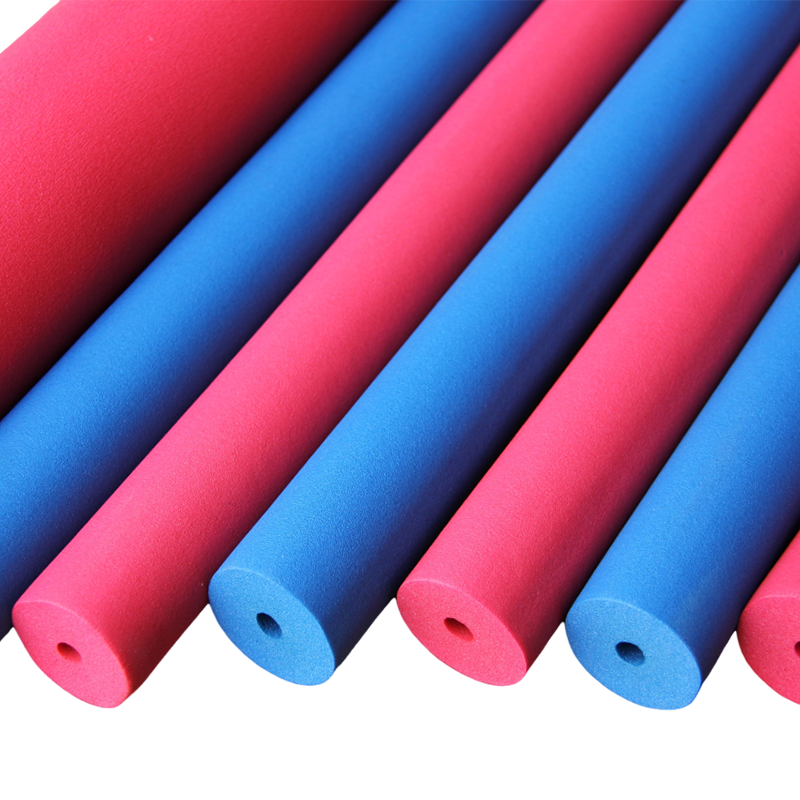
Recent industry analyses highlight a significant shift in the commercial refrigeration sector. Facility managers are increasingly abandoning traditional rigid foams in favor of advanced elastomeric solutions that offer rapid deployment and fail-safe moisture control in extreme environments.
Serving as the workhorses of the industry, standard tubes are perfectly suited for HVAC chilled water lines and medium-temperature refrigeration systems where fluids hover just above or slightly below freezing. Available in standard lengths with varying wall thicknesses, they deliver a highly cost-effective baseline for general commercial cooling.
Deep-freeze storage rooms, pharmaceutical blast freezers, and cryogenic facilities push temperatures down to a punishing negative forty degrees Celsius or lower. Standard off-the-shelf foam will become brittle and shatter under these extremes. Heavy-duty cryogenic variants are formulated with specialized polymer blends to remain supple at ultra-low temperatures. Furthermore, these products utilize ultra-thick walls or employ multi-layered staggering techniques to completely eradicate deep-freeze condensation.
Retrofitting an active, dripping pipe network presents a logistical nightmare. Shutting down the entire plant to slide continuous tubes over disconnected lines is rarely an option. Pre-slit and self-adhesive tubes solve this beautifully. Manufactured with a precise longitudinal cut and a factory-applied adhesive strip, contractors simply snap the insulation over the active pipe, peel the release liner, and press. This self-sealing mechanism slashes labor hours and guarantees a flawless seal without the mess of liquid adhesives.
Guesswork in insulation sizing inevitably leads to catastrophic system failures. Buyers and engineers must apply a rigorous, practical framework to calculate exact dimensional needs.
Achieving an absolute, glove-like fit is non-negotiable. The inner diameter of the foam must perfectly mirror the outer diameter of the copper or steel pipe. If the fit is too loose, longitudinal air channels form. This allows hidden condensation to pool and corrode the metal from the outside in. Conversely, forcing a tube onto an oversized pipe stretches the elastomeric walls. This crushes the microscopic closed cells and instantly destroys the insulating capacity.
Pinpointing the correct wall thickness is a balancing act involving three primary variables. You must consider the facility ambient temperature, the relative humidity of the surrounding air, and the operating line temperature of the refrigerant. For instance, a suction line running at negative ten degrees Celsius in a dry room might only need a three-quarter inch thick barrier. However, if that same pipe runs through a humid processing area hitting eighty-five percent relative humidity, engineers must consult psychrometric charts and likely upgrade to a two-inch thick tube to keep the surface above the dew point.
Industrial-scale ammonia or carbon dioxide refrigeration systems frequently utilize heavy-duty, non-standard pipe schedules. Standard residential sizes simply fall short. Procurement teams must actively seek out manufacturers equipped with custom extrusion capabilities. Securing custom-sized Rubber Insulation Tube products ensures a flawless fit for specialized systems. This eliminates risky on-site modifications that threaten the integrity of the vapor barrier.
To fully validate the investment in elastomeric technology, one must compare field performance and installation realities against legacy materials still lingering in the industrial sector.
While polyurethane foam boasts excellent thermal resistance, its extreme rigidity is a massive liability. Imagine a contractor suspended on a scissor lift, struggling to fit rigid half-shells around a cluster of expansion valves in a cramped, freezing ceiling space. The sheer volume of mastic sealant required at every joint drives up labor costs astronomically. Elastomeric rubber navigates complex pipe geometries effortlessly. This drastically reduces installation time while preserving a continuous, unbroken thermal shield.
Fiberglass remains a staple for high-heat applications, but it is a disastrous choice for sub-zero cold storage. Featuring an open-cell structure, it relies entirely on a thin external foil jacket to block moisture. In a bustling warehouse, these jackets are easily punctured by forklifts or maintenance tools. Once breached, the fiberglass acts like a sponge, absorbing ambient humidity. This leads to an immediate loss of thermal resistance, aggressive pipe corrosion, and the rapid proliferation of toxic mold. Rubber inherent closed-cell matrix neutralizes this risk entirely.
Even the most premium insulation will fail spectacularly if installed with poor technique. Careless installation creates hidden pathways for moisture and heat, rendering the entire system ineffective.
Every seam, butt joint, and termination point represents a critical vulnerability. Installers must never rely on simple friction fits or zip ties. It is mandatory to use manufacturer-approved liquid contact adhesives. These chemicals physically melt and bond the rubber surfaces together, forging a continuous, impenetrable vapor barrier. Furthermore, wrapping specialized elastomeric tape over these glued seams adds a secondary layer of mechanical defense against thermal bridging.
A notoriously common failure point occurs right at the pipe supports. If a heavy, fully loaded liquid line rests directly on a standard metal clevis hanger, the sheer weight crushes the flexible foam underneath. This localized compression squeezes out the trapped air cells, creating a cold spot where ice rapidly forms. To combat this, contractors must utilize rigid insulated pipe saddles or high-density polyurethane blocks. These bear the structural load without compromising the thickness of the surrounding rubber shield.
For B2B procurement managers handling large-scale commercial developments, sourcing bulky materials internationally requires meticulous vetting of global supply chains.
When assessing potential overseas partners, scrutinize their factory capacity and technological infrastructure. The ability to consistently extrude high-quality elastomeric materials at a massive scale is crucial. Buyers should demand comprehensive technical data sheets and recent batch testing reports from in-house laboratories. This verifies that the supplier consistently hits the advertised thermal conductivity and water vapor resistance values.
Commercial construction materials are heavily regulated. Global buyers must guarantee that sourced products comply with the specific legal frameworks of their destination region. Essential benchmarks include CE marking for the European market and ASTM standards for North America. RoHS compliance is also necessary to ensure the absence of hazardous chemicals. UL classifications are highly recommended to satisfy local building inspectors and commercial insurance underwriters.
Importing lightweight but high-volume foam materials presents unique freight challenges. Shipping costs can devour project budgets if not managed carefully. Procurement teams should negotiate minimum order quantities that align perfectly with their construction phasing to maximize shipping container density. Additionally, always request physical product samples prior to bulk commitments to test material density, cellular structure, and flexibility.
Selecting the optimal elastomeric thermal barrier is a highly strategic investment. It directly enhances the operational longevity of commercial cold storage facilities while significantly driving down daily energy consumption. By prioritizing exceptionally low thermal conductivity, demanding precise custom sizing, and enforcing strict installation protocols, facility managers can permanently eliminate the nightmare of costly condensation and ice damage.
Are you ready to optimize your refrigeration network? Explore the high-performance solutions at Lukwom. Contact our engineering team today via lukwom.com for a detailed project consultation. You can request a physical sample of our premium materials for in-house testing or get a customized quote tailored to your exact piping dimensions.
When installed indoors and shielded from physical abuse, high-quality elastomeric foam can easily last fifteen to twenty years, or even longer. This impressive longevity is heavily dependent on meticulous installation and the proper chemical sealing of all seams. As long as the closed-cell structure remains uncrushed and unpunctured, it will maintain its thermal and moisture-resistant integrity for decades.
Yes, they are frequently utilized in outdoor rooftop refrigeration applications, but they demand robust protection. Prolonged exposure to harsh ultraviolet radiation and extreme weather will eventually degrade the rubber compound. To prevent this, the insulation must be shielded with a protective metal aluminum cladding or heavily coated with a specialized, UV-resistant elastomeric paint immediately following installation.
Pipe sweating is fundamentally a symptom of inadequate insulation thickness or poorly sealed joints that allow ambient air to reach the cold metal. When the thermal barrier is too thin, its outer surface temperature drops below the room dew point. The definitive solution is to upgrade to a thicker layer of elastomeric foam, calculated specifically for your room maximum humidity, and to ensure every single seam is hermetically sealed with contact adhesive.
No, a separate external vapor barrier is completely unnecessary. The inherent, microscopic closed-cell architecture of the material functions as a built-in, highly effective vapor retarder. Because each individual bubble is sealed off from the next, water vapor cannot migrate through the foam. This structural advantage saves contractors significant time and material costs compared to wrapping fiberglass or mineral wool systems.
Flexible closed-cell elastomeric rubber is widely considered the best choice for commercial cold water and refrigeration lines. Its built-in vapor barrier effectively prevents condensation, while its flexibility allows for seamless installation around complex pipe fittings, valves, and tight corners where rigid materials often fail.
The required thickness depends heavily on the ambient temperature, relative humidity, and the operating temperature of the refrigerant. While standard chilled water lines might only require a half-inch to three-quarter-inch thickness, deep-freeze refrigeration lines operating in highly humid environments often demand a thickness of two inches or more to prevent dangerous surface condensation.


