
Tel:
+86-551-6346-0808
Factory Add:
Plant 5-6, Zhongnan High Tech Industrial Park, Zhegao, Chaohu City, Anhui. 

Views: 0 Author: Site Editor Publish Time: 2026-06-28 Origin: Site
The stakes in modern HVAC piping are incredibly high. The integrity of an entire refrigeration or climate control system relies directly on its joints. When you use the wrong components, fitting failures happen quickly. These failures lead to severe refrigerant leaks, sudden pressure drops, and catastrophic compressor damage.
This discussion moves far beyond basic plumbing. HVAC applications demand specific manufacturing tolerances, high pressure ratings, and uncompromising cleanliness standards. Standard residential plumbing components simply cannot meet these rigorous technical demands. You need parts engineered specifically for refrigerant behavior.
This article provides a robust technical framework for your next installation. We outline how to evaluate and source the correct components for your systems. You will learn exactly how to select the right configurations specifically engineered for commercial and residential HVAC lines. This ensures your climate control infrastructure operates safely and efficiently for years.
ACR vs. Plumbing Grades: HVAC applications require ACR (Air Conditioning and Refrigeration) copper fittings, which are nitrogen-purged, capped, and sized by Outside Diameter (OD), unlike standard plumbing fittings sized by Nominal Inside Diameter (ID).
Flow Dynamics Dictate Shape: Selecting between a copper elbow, copper tee, or copper reducer isn’t just about geometry; it’s about managing pressure drops and maintaining oil return in the system.
Wall Thickness Matters: Type K and Type L copper tubing dictate the fitting requirements; Type M is generally unacceptable for pressurized HVAC refrigerant lines.
Joining Methods Impact Sourcing: The choice between brazed joints and mechanical press-fit systems changes the fitting specifications and installation risk profile.
Procurement teams often confuse water-grade plumbing fittings with HVAC-grade components. This error causes system contamination and sizing mismatches during installation. You must clearly distinguish between the two product categories.
ACR components comply with ASTM B280 standard, featuring strict internal cleanliness. Manufacturers dehydrate, degrease the parts and seal the ends to avoid contamination in transit. Microscopic dirt or moisture will react with refrigerants to form corrosive acids, damaging compressors and causing system failure. Always use dedicated HVAC copper fittings for refrigerant lines.
Sizing rules are another major pitfall: ACR copper is measured by Outside Diameter (OD), while standard water tube (ASTM B88) uses nominal size based on Inside Diameter (ID). A 7/8-inch ACR fitting is not interchangeable with a 7/8-inch nominal plumbing fitting, and mismatching will destroy joint integrity.
Important Note: Do not remove factory caps from ACR components until installation. Early exposure will let moisture enter the tubing.
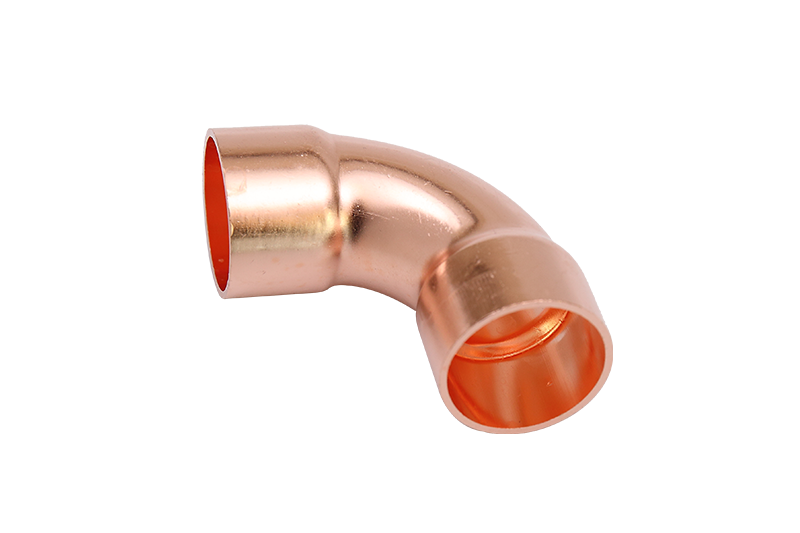
We must break down the specific selection criteria for the most common directional components. You base these choices on HVAC flow dynamics and complex refrigerant behavior. Geometry plays a major role in system efficiency.
Piping often needs to bypass structural obstacles. Elbow radius determines system performance at bends.
Long-radius elbows are the industry standard for HVAC. Their gentle curve reduces friction loss and turbulence, and guarantees smooth oil return for compressors. Short-radius elbows restrict flow and trap oil, eventually leading to compressor damage.
For angle selection, use two 45-degree turns instead of one 90-degree turn if space permits. This cuts equivalent pipe length and maintains optimal refrigerant velocity.
Copper tees are essential for multi-zone climate systems. Two main types apply to different scenarios:
Straight-through tee: Most fluid flows straight, with only a portion diverted to branches.
Bullhead tee: Forces fluid to collide and split sharply.
Improper tee selection leads to uneven refrigerant distribution. Match branch sizes to the load demand of each zone strictly.
Copper reducers adjust pipe diameters to control refrigerant velocity, mainly divided into concentric and eccentric types:
Concentric reducers: Symmetrical structure, only for vertical piping.
Eccentric reducers: Mandatory for horizontal piping, installed with the flat side downward.
Using concentric reducers on horizontal lines creates internal lips, where compressor oil accumulates and causes mechanical failures.
Copper tubing is classified by wall thickness, and pressure requirements decide the matching fittings.
Tube Type | Wall Thickness Category | Primary Use Case | HVAC Suitability |
|---|---|---|---|
Type K | Heavy Wall | Underground, Commercial Chillers | Excellent (High Pressure) |
Type L | Medium Wall | Standard Refrigerant Lines | Standard / Highly Recommended |
Type M | Light Wall | Residential Domestic Water | Unacceptable (Do Not Use) |
Installation methods determine part selection. Two mainstream solutions are available:
As the traditional solution, brazing forms durable joints for high-pressure refrigerants with 15% silver solder. Nitrogen purging during heating prevents internal oxidation.
Drawbacks: Requires hot work permits, highly skilled workers and longer installation time.
A modern flame-free alternative (represented by ZoomLock, RLS) features fast installation and zero fire risks, with no need for hot work permits.
Drawbacks: Needs dedicated expensive tools, and service life relies entirely on the integrity of internal HNBR O-rings. Seal damage before pressing will cause future leaks.
Comparison Chart: Brazing vs. Press Fitting Characteristics | ||
Feature / Requirement | Traditional Brazing | Mechanical Press Fittings |
|---|---|---|
Fire Risk / Hot Work Permit | High Risk / Required | Zero Risk / Not Required |
Installation Speed | Slower (Requires Nitrogen Purging) | Very Fast (Crimp and Go) |
Labor Skill Level | Highly Skilled Tradesperson | Moderate Training Required |
Sealing Mechanism | Fused Metal Alloy (15% Silver) | Compressed HNBR O-Ring |
For bulk procurement, evaluate suppliers based on the following technical indicators:
Material purity: Choose Cu-DHP (Deoxidized High Phosphorus) copper with 99.9% purity to avoid hydrogen embrittlement and metal cracking.
Manufacturing tolerance: Loose fittings cause brazing failure; over-tight sizes increase installation difficulty. Strict tolerances ensure perfect matching.
Certifications: Require UL recognition for high-pressure refrigerant resistance and full ASME B16.22 compliance. Check relevant documents before placing orders.
Correct component selection needs comprehensive consideration of material grade, fitting structure and connection methods. Any negligence will threaten the whole piping system.
Follow these steps before procurement and construction:
Check piping schematics against refrigerant pressure requirements.
Confirm connection methods (brazing or press-fit) with mechanical engineers.
Unify OD sizing standards with the procurement team.
Collect ASME and UL compliance documents from potential suppliers.
A: No. Plumbing fittings fail to meet cleanliness standards for refrigerants, and their sizing rules do not match ACR tubing.
A: A long radius elbow creates less pressure drop and friction, supporting stable system operation and normal oil return.
A: Size by pipe OD. Use eccentric reducers on horizontal lines to prevent oil accumulation.
A: Fittings for modern refrigerants such as R-410A generally need a continuous operating pressure rating of at least 700 psi, subject to system design and local codes.


