
Tel:
+86-551-6346-0808
Factory Add:
Plant 5-6, Zhongnan High Tech Industrial Park, Zhegao, Chaohu City, Anhui. 

Views: 0 Author: Site Editor Publish Time: 2026-07-10 Origin: Site
Slow vacuum pull-down wastes plenty of unbillable time for HVAC technicians. System evacuation is essential to remove non-condensable gases and trapped moisture, preventing acid formation and compressor failure. Proper vacuum pump selection needs balanced consideration of CFM, ultimate vacuum level and durability, to avoid overspending or insufficient performance. This guide helps you pick suitable pumps to boost work efficiency and profits.
Sizing rule: 1 CFM per 7 tons of system capacity; hose size largely limits actual flow rate.
Two-stage pumps are required to reach the standard 500-micron deep vacuum.
Regular oil maintenance is critical; reliable oil change design is a core selection factor.
Cordless pumps fit mini-splits and automotive AC, while corded types are a must for large commercial rooftop units.
Undersized pumps prolong evacuation time and reduce daily service volume. Oversized models add extra cost and weight, yet narrow hoses will still restrict flow and hold back performance.
Modern HVAC systems use hygroscopic POE oil. Residual moisture will react with refrigerant and oil to form corrosive acid, damaging compressors. Most manufacturers require a verified 500-micron vacuum to keep warranties valid.
Cheap pumps fail easily when handling contaminated systems with sludge and excess moisture. Professional-grade units support long continuous operation without performance decline.
Feature | Single-Stage Pump | Two-Stage Pump |
|---|---|---|
Rotor Design | One rotor | Two rotors in series |
Ultimate Vacuum | ~1000 to 800 microns | 15 to 25 microns |
Primary Application | Degassing, basic auto repair | Professional HVAC/R service |
System Suitability | Not recommended | Mandatory for 500-micron target |
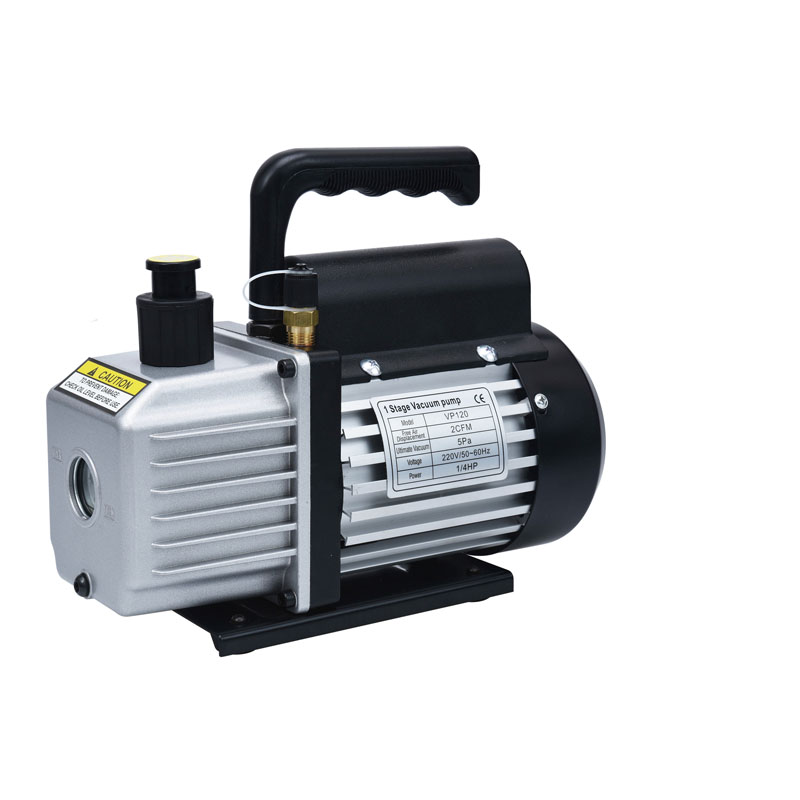
Single-stage pumps cannot reach qualified deep vacuum, so they are not for formal HVAC work. Two-stage pumps deliver strong pulling power and are the industry standard.
3–5 CFM fits residential and light commercial systems under 25 tons; 7–10 CFM is for large commercial units.
Note: Standard 1/4-inch hoses and Schrader valves create severe flow bottlenecks. Higher CFM will not work to its full potential without upgraded fittings and large-bore hoses.
Choose pumps rated for 15–25 microns. This performance reserve ensures stable 500-micron vacuum under complex on-site conditions.
AC motor: Sturdy and long-lasting for heavy-duty continuous use.
DC motor: Lightweight, energy-efficient and quiet.
Spark-proof / A2L compliant motor is mandatory for working with flammable refrigerants like R-32 and R-454B for safety.
Pump oil acts as sealant and moisture absorber. Milky saturated oil will ruin vacuum performance. Prioritize units with wide oil fill ports, large sight glasses and run-and-drain design for convenient oil replacement.
Light aluminum housings ease frequent carrying for residential jobs. Heavy cast-metal bodies feature better impact resistance, ideal for commercial units staying on site for long hours.
This function stops internal moisture condensation during evacuation, keeps oil clean and maintains stable pump efficiency.
Automotive AC: 1.5–3 CFM, single/two-stage. Prioritize compact size and portability.
Residential HVAC: 4–6 CFM two-stage. Cordless models work well for mini-splits in hard-to-reach areas.
Large Commercial Systems: 8–12 CFM heavy-duty two-stage AC pumps, designed for long runtime. Match with large-diameter hoses to maximize flow.
Select pumps based on your regular system tonnage, and stick to two-stage types with user-friendly oil systems. To fully leverage pump performance, replace old valves with core removal tools and use 1/2-inch or 3/4-inch large-bore hoses. Use an independent micron gauge to get accurate vacuum readings. These combinations greatly cut evacuation time.
A: 2–3 CFM is enough. Larger pumps add weight without improving speed.
A: No. Narrow standard hoses limit flow. Upgrade hoses and valves first to realize higher CFM performance.
A: Change oil after every evacuation, or immediately once it turns milky.
A: No. It is illegal and will damage the pump. Use a dedicated recovery machine instead.


