
Tel:
+86-551-6346-0808
Factory Add:
Plant 5-6, Zhongnan High Tech Industrial Park, Zhegao, Chaohu City, Anhui. 

Views: 0 Author: Site Editor Publish Time: 2026-07-05 Origin: Site
Every day, HVAC technicians work under tough field conditions. Carrying heavy tools on ladders and hot commercial rooftops calls for fast, accurate diagnostic equipment. Technicians face a common dilemma: basic pressure gauges are durable and easy to use for quick checks, while full manifold sets deliver comprehensive analysis yet add extra weight. Wrong tool selection leads to misdiagnosis, costly callbacks and dissatisfied customers. Overusing high-end tools for simple tasks also slows down work and accelerates tool wear. This guide helps you select proper tools and standardize kits for individual technicians or service teams. You will learn when to use a standalone gauge and when a complete manifold system is necessary for refrigerant pressure testing.
A standard pressure gauge is single-function gear, ideal for quick pressure checks with minimal refrigerant loss and no system contamination.
A full manifold gauge set is essential for system charging, evacuation and dual high/low pressure monitoring.
Most technicians use both tools; wireless probes serve as a practical middle solution between single gauges and manifolds.
Digital manifold gauges cut down superheat and subcooling calculation errors, improving work efficiency and economic benefits.
A standalone gauge only measures pressure at a single point for either high-pressure or low-pressure lines. It has no internal valves or extra ports. It features simple structure, strong durability, easy calibration and low replacement cost even after accidental drops.
A manifold gauge set acts as a professional diagnostic hub. Equipped with dual gauges, valves and multiple hose ports, it monitors high and low pressures simultaneously and supports refrigerant transfer. It offers powerful analysis functions, yet needs regular maintenance for hoses, O-rings and body parts. It also costs more, and digital models have a longer learning curve for new workers.
Standalone gauges are perfect for rapid inspection and routine maintenance when full diagnostics are unnecessary.
They effectively reduce refrigerant leakage. Manifold hoses will inevitably cause minor refrigerant venting, while single gauges or low-loss fittings avoid this issue. This advantage is critical for small systems like household refrigerators, ice machines and mini-splits, which hold a limited volume of refrigerant. Even a small amount of loss will impair system performance.
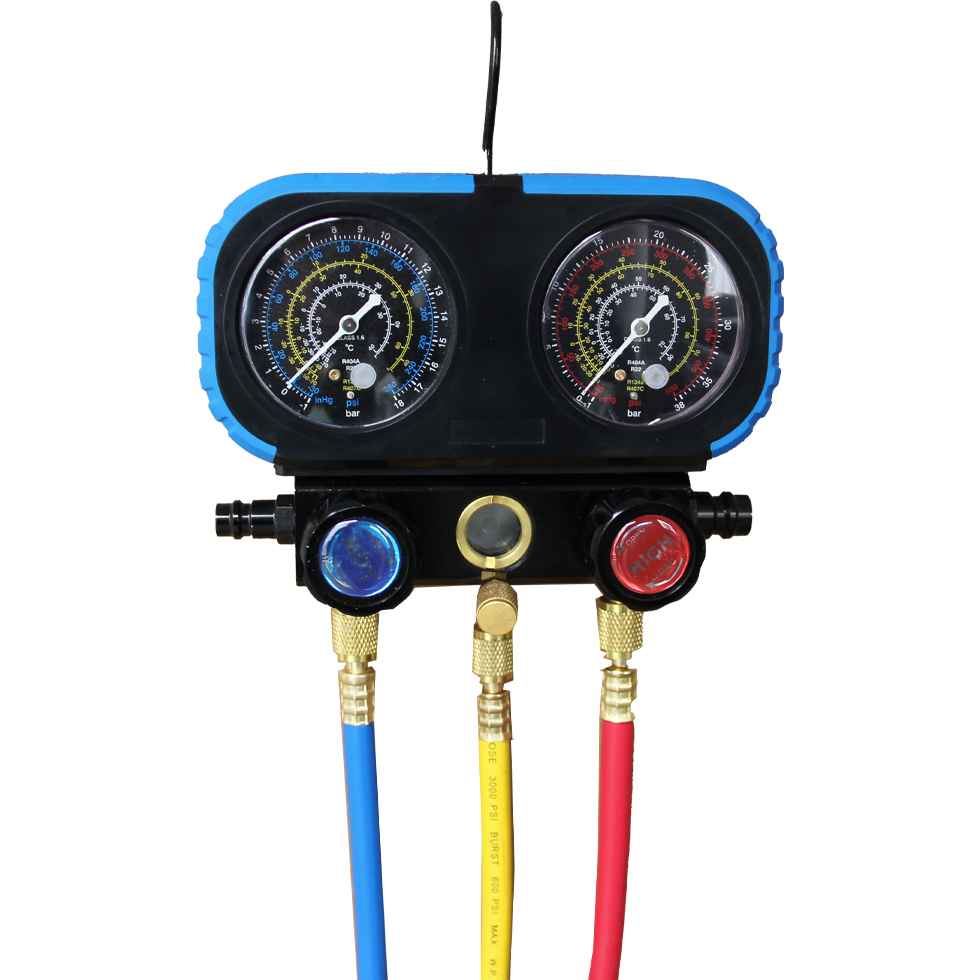
Dual pressure readings from a manifold are required to analyze the complete refrigeration cycle. It quickly identifies flow restrictions, compressor faults and metering device problems.
The multi-port central block connects vacuum pumps, recovery cylinders and refrigerant tanks at the same time, enabling efficient evacuation and charging without frequent hose replacement. Matched with temperature clamps, it collects data for superheat and subcooling calculation, supporting equipment commissioning and complex troubleshooting.
In addition, standard manifold operation complies with EPA Section 608 regulations for refrigerant management, avoiding environmental pollution and regulatory fines.
Diagnostic tools have evolved from traditional dials to smart devices.
Analog manifolds: No battery needed, resistant to harsh environments and budget-friendly. Drawbacks include reading errors and manual PT chart lookup.
Digital manifolds: Auto-calculate superheat and subcooling, store refrigerant data and support data logging. They deliver higher precision, but cost more and are affected by low temperatures and power issues.
Wireless smart probes: Connect to mobile phones for pressure and temperature testing. They cut tool weight and refrigerant loss, but cannot replace manifolds for charging and recovery work.
Tool Type | Primary Use Case | Superheat & Subcooling | Charging & Recovery Capable |
|---|---|---|---|
Analog Manifold | Basic diagnostics, heavy-duty recovery | Manual Calculation Required | Yes (Integrated Block) |
Digital Manifold | Precision commissioning, detailed reporting | Automatic (Onboard Processor) | Yes (Integrated Block) |
Wireless Probes | Quick triage, low-loss diagnostics | Automatic (Via Smartphone App) | No (Requires Separate Manifold) |
Three key points for tool configuration:
Technician experience: Analog sets help apprentices learn refrigeration principles, while digital tools boost efficiency for skilled workers.
ROI & on-site efficiency: Digital tools shorten working hours, reduce callbacks and create tangible cost savings.
Unified tool ecosystem: Choose products from one brand to ensure compatibility and simplify team management and training.
Standalone pressure gauges fit quick inspections and small refrigerant systems. Manifold sets are indispensable for deep troubleshooting, evacuation and charging work.
The recommended solution is a hybrid collocation: use simple gauges for daily maintenance, and equip accurate digital manifolds for professional servicing and new unit installation. This method balances efficiency and tool protection.
Optimize your toolkit now. Explore our manifold gauge selections, check technical specs, or contact our team for fleet purchase discounts.
A: Yes. Use analog sets as a backup. Digital devices may fail due to dead batteries or low temperature.
A: Digital gauges need zeroing before each use. Formal calibration follows manufacturer rules; commercial equipment usually requires annual certified calibration to meet ISO standards.
A: It is technically possible after purging, but not recommended due to cross-contamination risks. Use dedicated sets for different refrigerants.
A: They work well for diagnostics, but manifolds are still required for charging, evacuation and refrigerant recovery.


