
Tel:
+86-551-6346-0808
Factory Add:
Plant 5-6, Zhongnan High Tech Industrial Park, Zhegao, Chaohu City, Anhui. 

Views: 0 Author: Site Editor Publish Time: 2026-06-30 Origin: Site
Moisture and debris act as silent killers within modern refrigeration circuits. They are top causes of premature compressor failure and severe acid buildup in piping. A reliable copper filter drier intercepts these contaminants before they damage key components. Without proper moisture control, HVAC equipment will degrade rapidly and face irreversible breakdown.
This guide introduces the functions, material advantages, replacement rules and procurement standards of copper filter driers, helping extend the service life of refrigeration systems.
Core Function: Copper filter driers provide moisture control and mechanical filtration, preventing sludge and acid formation in refrigerant lines.
Material Superiority: Solid copper housings avoid galvanic corrosion and work perfectly for brazing, outperforming steel.
Replacement Triggers: Replace the unit once the sealed system is opened, after compressor burnout, or when obvious temperature/pressure drop occurs.
Strategic Placement: Indoor installation offers better weather protection; liquid line and suction line placements serve different operational purposes.
Modern HVAC systems adopt POE lubricant oil, which easily absorbs moisture. Mixed moisture and oil will form corrosive acids and burn out compressors.
A filter drier removes contaminants via two core structures:
Desiccant Core: Molecular sieves trap moisture, while activated alumina absorbs acids.
Mechanical Filtration: Internal screens and fiberglass pads block copper shavings, brazing scale and other solid debris.
Liquid Line Drier: Installed after the condenser and before the expansion valve, preventing valve clogging. Standard for new systems.
Suction Line Drier: Mounted right before the compressor, mainly used to clear sludge after compressor burnout. It needs removal after cleanup.
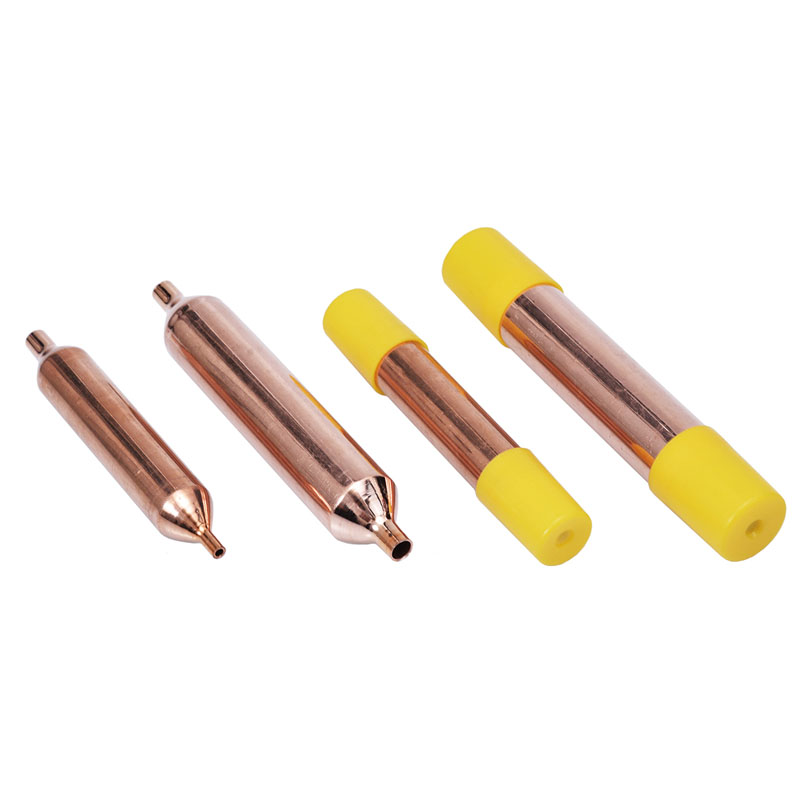
Solid spun copper housings have distinct advantages over steel and brass:
Superior Corrosion Resistance: Copper never rusts, even in coastal salty air or high-humidity environments, eliminating pinhole leaks caused by rust.
Optimal Brazing Performance: Copper-to-copper brazing creates firm, seamless joints. It also avoids galvanic corrosion that happens when connecting steel and copper.
Strong Vibration Tolerance: Seamless copper structure withstands compressor vibration without cracking, unlike steel driers with welded or crimped seams.
Follow these evidence-based rules for replacement:
Diagnostic Method | Warning Threshold | Required Action |
|---|---|---|
Temperature Differential | > 2°F to 3°F drop across unit | Replace immediately due to restriction |
Pressure Gauges | Measurable pressure drop detected | Replace immediately due to physical clog |
Sight Glass Color | Indicator paper turns Yellow | Replace immediately due to moisture saturation |
System Servicing | Hermetic seal broken for any repair | Mandatory replacement prior to vacuum |
Outdoor installation: Easy for maintenance, but exposed to UV rays and physical damage.
Indoor installation: Fully protected from harsh weather, the preferred choice for engineers to safeguard the expansion valve.
Follow OEM specifications for placement to keep warranties valid. Secure piping firmly to reduce vibration on brazed joints.
Critical Tip: Wrap the drier with a wet rag during brazing for heat dissipation. Excessive heat will damage internal desiccant and ruin the unit.
Match the drier size to system tonnage. Undersizing leads to flow restriction. Ensure the housing is rated for your refrigerant (R-410A, R-32, R-22 etc.) and corresponding working pressure.
Feature | Sweat (ODF) Connections | Flare (SAE) Connections |
|---|---|---|
Installation Method | High-temperature brazing required | Mechanical threading via wrenches |
Leak Potential | Extremely low (permanent seal) | Moderate (requires precise torque) |
Best Application | Commercial systems, permanent installs | Residential systems, frequent access |
Tools Needed | Oxy-acetylene torch, silver solder, nitrogen | Torque wrenches, flaring tool |
New installations: Choose blends rich in molecular sieves for strong moisture absorption.
Post-burnout repairs: Select blends with high-content activated alumina to neutralize acids.
A copper filter drier is cost-effective protection for high-value HVACR equipment. Copper material solves rust and corrosion issues, while standardized replacement and selection rules guarantee stable system operation.
Action Advice: Check sight glasses for moisture alerts regularly, and select properly sized copper filter driers in advance during routine maintenance.
Q: Can a copper filter drier be cleaned and reused?
A: No. Once saturated or clogged, it must be replaced entirely.
Q: Does installation direction matter?
A: Yes. It is directional. Follow the flow arrow on the housing to avoid flow restriction.
Q: What is the typical service life?
A: It can last 10–15 years in a well-sealed system, but must be replaced whenever the system is opened for repairs.s opened for repairs.


