
Tel:
+86-551-6346-0808
Factory Add:
Plant 5-6, Zhongnan High Tech Industrial Park, Zhegao, Chaohu City, Anhui. 

Views: 0 Author: Site Editor Publish Time: 2026-08-12 Origin: Site
Chilled water systems face some of the harshest mechanical conditions imaginable. Operating continuously between 35°F and 45°F, these pipelines demand flawless thermal protection. The challenge lies heavily in managing moisture. Ambient humidity naturally seeks out cold pipe surfaces, inevitably causing destructive condensation. Without an impermeable barrier, this moisture degrades thermal efficiency and damages surrounding structural infrastructure. You will also see accelerated Corrosion Under Insulation (CUI) quickly taking hold.
While open-cell fibrous materials rely entirely on fragile exterior vapor jackets, there is a vastly superior approach. Specifying a structural Rubber Insulation Tube shifts the moisture defense directly to the material itself. We will explore how inherently closed-cell structures prevent these catastrophic system failures. You will learn why built-in vapor resistance matters far more than added exterior layers. Finally, we will show you how proper specification practices drastically reduce long-term operational risk.
Built-in Vapor Barrier: The fundamental advantage of closed cell rubber insulation is its inherent resistance to water vapor transmission throughout its entire thickness.
Condensation Control is Priority One: Success in chilled water applications relies on accurate thickness calculations based on ambient temperature, fluid temperature, and maximum expected relative humidity (RH).
Installation dictates Lifespan: Even premium materials will fail if butt joints, longitudinal seams, and termination points are not chemically bonded under strict installation protocols.
We must fully understand the dew point dynamic. Ambient air constantly holds invisible water vapor. When this warm air touches a chilled water pipe, the air temperature drops rapidly. Cold air holds significantly less moisture. Engineers rely on psychrometric charts to predict these specific failure thresholds. When the ambient air reaches the pipe surface temperature, water vapor transforms instantly into liquid droplets. This physical process happens continuously if you lack proper thermal protection. Preventing this sweating relies entirely on absolute condensation control.
Failing to stop condensation causes severe cascading damage across a facility. You will typically notice dripping ceilings first. Moisture then compromises surrounding architectural integrity. Drywall panels absorb the water and soften quickly. Mold growth follows shortly after in dark ceiling plenums. Your mechanical equipment suffers extensively too. Wet insulating materials lose their thermal resistance. This forces building chillers to work much harder. They consume massive spikes in electrical energy just to maintain basic set points.
Moisture also poses a devastating hidden danger. Sometimes water gets permanently trapped between the metal pipe wall and the insulation layer. This creates a perfect micro-environment for Corrosion Under Insulation (CUI). Carbon steel pipes remain especially vulnerable to this phenomenon. The trapped water acts as a persistent electrolyte. It accelerates the metal rusting process silently over months. You might not notice the degradation until a main pipe completely ruptures. Effective materials eliminate this hidden threat.
Structural differences dictate exactly how materials handle threatening moisture. We classify open-cell materials like fiberglass or mineral wool as highly permeable. They suffer heavily from capillary action. When moisture enters, the fibers wick the water deeply into the matrix. They rely entirely on an external All-Service Jacket (ASJ) to survive. This ASJ acts as the sole vapor retarder. A single surface pinhole compromises the entire system. Water easily travels throughout the porous inner layer.
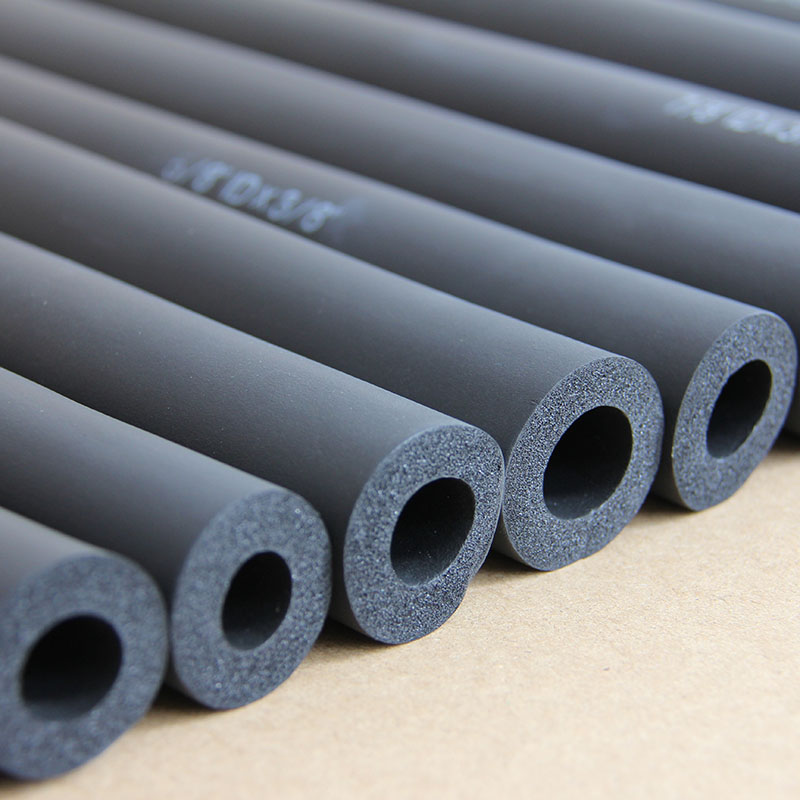
In sharp contrast, closed cell rubber insulation behaves completely differently. It features millions of discrete, nitrogen-filled microscopic cells. These tiny pockets block water vapor naturally. A localized surface puncture does not compromise the underlying vapor resistance. The defense mechanism exists consistently throughout the entire material thickness. You never have to worry about water wicking down the pipeline.
We measure overall insulating capacity using thermal conductivity or k-value. Fibrous materials lose this vital capacity drastically when they get wet. Water conducts heat roughly twenty times faster than stagnant trapped air. Once damp, open-cell materials fail thermally. Elastomeric rubber maintains a highly stable k-value instead. It resists water intrusion completely under normal conditions. You get perfectly reliable thermal performance even in high-humidity mechanical environments.
Mechanical equipment rooms rarely offer generous excess space. Thick layers of fibrous materials consume valuable installation clearances rapidly. Elastomeric materials require a significantly smaller profile to work. They achieve the necessary thermal and moisture barriers highly efficiently. This compact sizing makes them exceptionally suitable for tight commercial areas.
Performance Feature | Closed Cell Elastomeric Rubber | Open-Cell Fibrous Materials |
|---|---|---|
Vapor Barrier Type | Built-in structural resistance | External fragile jacket (ASJ) |
Puncture Vulnerability | Low (Damage remains localized) | High (System-wide compromise) |
Moisture Permeability | Extremely low | Extremely high |
Capillary Action (Wicking) | None | Severe |
Space Efficiency | Excellent (Compact profile) | Poor (Bulky and thick) |
Engineers must evaluate multiple critical factors when selecting an HVAC rubber tube for commercial projects. The most important metric is Water Vapor Permeability (WVP). You should exclusively look for materials conforming to strict ASTM standards. These standards demand exceptionally low perm ratings. Typically, you want verified values around 0.08 perm-inch or lower. Lower ratings ensure far superior long-term moisture resistance.
You will encounter two primary material composition options in the market. Nitrile Butadiene Rubber (NBR) blended with PVC serves as the dominant industry standard. It works perfectly for indoor commercial chilled water piping systems. NBR offers excellent oil and chemical resistance. Ethylene Propylene Diene Monomer (EPDM) provides a different distinct advantage. We highly recommend EPDM for harsh outdoor environments. It features superior inherent UV resistance. EPDM also tolerates a much wider operating temperature range safely.
Safety regulations govern all indoor mechanical installations strictly. Your chosen material must meet regional commercial building codes. The ASTM E84 standard regulates flame spread and smoke-developed indexes rigorously. Most commercial municipal codes require a strict 25/50 rating for safe indoor use. Meeting this specific standard allows safe installation inside return air plenums. Always verify these compliance documents closely before granting project approval.
Even premium insulating materials fail miserably without proper installation techniques. The system is truly only as effective as its weakest sealed seam. You must specify exact, manufacturer-approved contact adhesives. These specialized glues chemically bond the material edges together permanently. They ensure a continuous, unbroken vapor barrier. Avoid relying solely on standard tapes for seams. Tape eventually degrades, dries out, and peels away.
Chilled water pipes contract physically when operating actively. Internal temperatures drop and the surrounding metal shrinks. Mechanical installations must explicitly account for this longitudinal movement. Otherwise, massive gaps open between pipe sections. You prevent this failure by applying the material under slight longitudinal compression. Installers push the butt joints together firmly during application. This simple technique absorbs seasonal pipe contraction easily.
Direct sunlight degrades certain rubber materials surprisingly quickly. Specifiers must acknowledge the chemical vulnerability of NBR to UV degradation. Unprotected NBR will crack, harden, and turn to powder over time. You must specify mandatory UV-protective liquid coatings. Rigid metallic or polymeric jacketing offers even better physical protection. Always cover exterior roof-mounted chilled water lines fully to prevent premature failure.
Pipe hangers present a major structural vulnerability. Heavy steel pipes crush flexible insulation easily at the support locations. Crushed cellular materials lose their critical thermal resistance immediately. Sweating quickly forms at these exact compressed points. You must prevent crushing by specifying high-density rigid support inserts. We often use Polyurethane (PUR) or specialized heavy-duty rubber blocks. Integrate these rigid inserts smoothly with the surrounding flexible sections.
Apply contact adhesives evenly to both opposing surfaces of a seam.
Allow the wet adhesive to become highly tacky before pressing seams together.
Compress butt joints slightly to absorb future metallic pipe contraction.
Seal all system termination points completely against the bare pipe wall.
Install rigid structural pipe support inserts at every single hanger location.
Selecting the correct material thickness requires highly precise environmental data. Do not simply guess the required dimensional size. You must calculate thickness using verified software tools or rigorous engineering tables. These tools follow established ASHRAE engineering guidelines very closely. They factor in ambient temperature, fluid temperature, and localized wind speed. Most importantly, you must design for the absolute most extreme local summer humidity variables. High ambient humidity demands significantly thicker material walls.
You must ensure strict regulatory compliance early in the design phase. The selected chilled water pipe insulation must meet minimum local energy codes. The International Energy Conservation Code (IECC) and ASHRAE 90.1 outline strict operational rules. They dictate the exact minimum thermal performance for specific pipe diameters. They also adjust performance requirements based dynamically on the flowing fluid temperatures.
Mechanical specifiers should demand technical documentation upfront. Request comprehensive Technical Data Sheets (TDS) for every single proposed product. Ask for independent third-party lab testing reports verifying WVP and thermal conductivity. Review official manufacturer warranties very closely. Ensure they actually cover both raw material defects and overall assembled system performance. Strong comprehensive warranties strongly indicate long-lasting product reliability.
Moisture management genuinely equals thermal retention in commercial chilled water networks. You cannot ignore one aspect without eventually destroying the other. Inherently closed-cell elastomeric structures address both critical challenges flawlessly. They stop aggressive moisture penetration while maintaining perfectly steady temperatures. Their unified physical design brilliantly eliminates the need for fragile secondary vapor jackets.
Take ample time to thoroughly evaluate your specific facility environment. Carefully note whether the mechanical pipes run mostly indoors or outdoors. Identify regions experiencing standard versus dangerously extreme summer humidity. Use this precise data to finalize your material choice safely between NBR and EPDM. Always calculate the exact mathematical thickness before issuing the final mechanical specification. Proper initial planning guarantees exceptional long-term operational success.
A: Thickness is driven by the necessity to keep the insulation's surface temperature strictly above the ambient dew point. It requires knowing the exact pipe size, internal line temperature, surrounding ambient temperature, and maximum expected relative humidity. Engineers use specialized calculation software to process these specific variables. This determines the exact thickness required to stop condensation.
A: In most indoor commercial applications, no. The closed-cell structure naturally acts as a highly effective built-in vapor retarder. It continuously blocks moisture without extra layers. Extreme cryogenic applications might occasionally require supplemental barriers. However, standard commercial chilled water systems operating above freezing temperatures do not need additional exterior vapor jackets.
A: High-quality elastomeric materials boast exceptional field longevity. When properly sized, installed with fully sealed joints, and protected from mechanical or UV damage, they endure for decades. A meticulously maintained mechanical installation can easily match the operational lifespan of the entire chiller system itself, typically spanning 15 to 20 years.
A: Yes, but you must proceed with extreme caution. You can only use manufacturer-approved, flexible, water-based elastomeric coatings. These specialized paints stretch and move seamlessly with the underlying rubber material. Standard architectural paints lack this critical flexibility. They will inevitably crack, peel, and flake off as the material expands and contracts.


