
Tel:
+86-551-6346-0808
Factory Add:
Plant 5-6, Zhongnan High Tech Industrial Park, Zhegao, Chaohu City, Anhui. 

Views: 0 Author: Site Editor Publish Time: 2026-07-14 Origin: Site
Selecting the correct AC Motor Capacitor is a critical engineering and procurement decision. An undersized, mismatched, or low-quality capacitor leads directly to motor stalling. It also causes severe overheating and premature equipment failure. Manufacturers build CBB60, CBB61, and CBB65 models using metallized polypropylene film technology. However, their physical enclosures differ significantly. Their unique safety ratings and thermal thresholds dictate entirely different applications. You cannot simply interchange them blindly. Doing so invites catastrophic mechanical failures and safety hazards. This guide provides a robust technical evaluation framework. It helps engineers and purchasers confidently select the right unit. You will learn how to properly size your components. We will also show you how to source the exact capacitor for specific motor applications.
Engineers must match the physical and chemical properties of a capacitor to the operating environment. Each capacitor type solves distinct mechanical challenges. They handle varying levels of heat, vibration, and spatial limitations. We break down the core solution categories below.
The CBB60 capacitor features a cylindrical, flame-retardant plastic shell. Manufacturers seal this shell tightly using epoxy resin. This specific construction method provides exceptional moisture resistance. It keeps internal components dry during prolonged exposure to humid environments. The CBB60 is highly cost-effective. It maintains stable capacitance over extremely long runtimes.
You will find these units in heavy-use residential and commercial appliances. Primary applications include washing machines, water pumps, and cleaning equipment. Standard industrial motors also rely heavily on this form factor. The cylindrical shape allows for easy bracket mounting inside spacious appliance housings.
The CBB61 capacitor utilizes a rectangular or square plastic box design. This specific shape solves strict spatial limitations. Engineers design these units with a low-profile footprint. It allows seamless integration into extremely tight motor housings. Many units feature simple mounting tabs. These tabs make assembly line installation fast and reliable.
This design fits perfectly inside compact consumer electronics. Primary applications include ceiling fans, exhaust fans, range hoods, and blowers. These devices lack the internal clearance required for bulky cylindrical capacitors. The CBB61 delivers the necessary starting torque without demanding excess physical space.
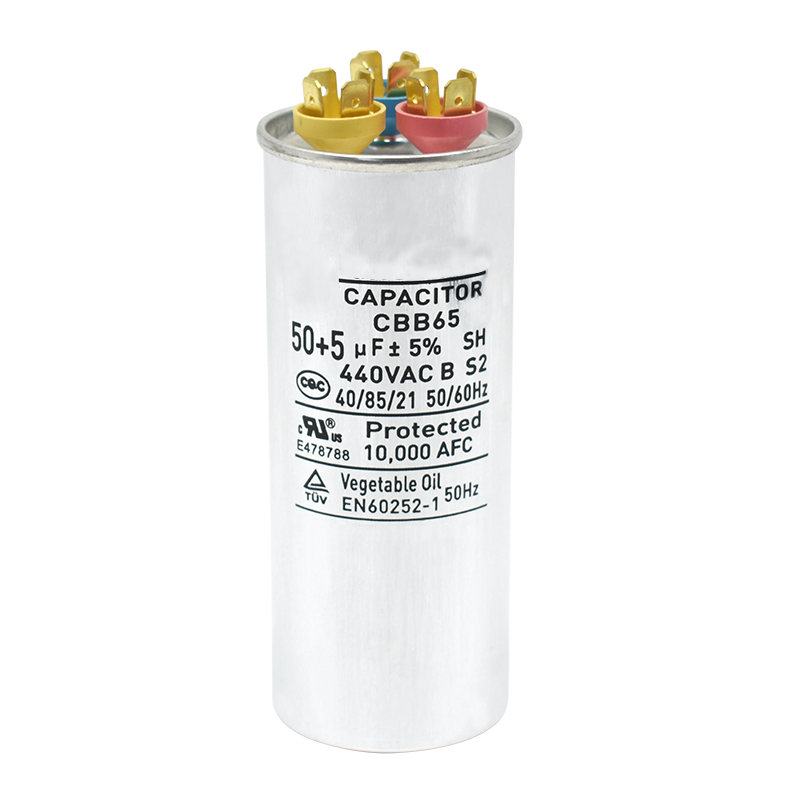
The CBB65 capacitor boasts a rugged cylindrical aluminum case. This metal casing delivers superior heat dissipation compared to plastic alternatives. High-heat environments demand this level of thermal management. Furthermore, the CBB65 features a vital mechanical explosion-proof design. It falls under the S2 safety class. If internal pressure builds up, the casing physically expands. This expansion disconnects the internal circuit. It completely prevents dangerous explosions.
You must use these capacitors in demanding environments. Primary applications include air conditioning units, refrigerators, and large HVAC compressors. High-vibration industrial environments also necessitate the aluminum casing. It withstands intense mechanical stress over decades of continuous use.
| Feature | CBB60 | CBB61 | CBB65 |
|---|---|---|---|
| Form Factor | Cylindrical Plastic | Rectangular Box | Cylindrical Aluminum |
| Sealing Method | Epoxy Resin | Epoxy Resin | Mechanical / Oil Filled |
| Safety Class | Typically S0 / S3 | Typically S0 | Strictly S2 (Explosion Proof) |
| Best For | Moisture Resistance | Tight Spaces | High Heat / Heavy Duty |
| Top Applications | Pumps, Washers | Fans, Blowers | HVAC, Compressors |
Selecting the wrong specifications leads directly to mechanical failure. Engineers must evaluate four distinct dimensions before approving a replacement or new installation. These criteria map specific features to critical performance outcomes.
Capacitance determines the amount of electrical energy the unit stores. Manufacturers measure this energy in microfarads (µF). You must strictly follow a simple rule of thumb here. The replacement capacitor must fall within ±5% to ±10% of the motor’s required microfarad rating. Do not guess or estimate this value.
Ignoring this rule introduces severe operational risks. Oversizing the unit increases motor current artificially. This generates excess heat. It ultimately degrades the copper windings inside the motor. Conversely, undersizing results in very poor starting torque. The motor will operate sluggishly. It might even stall completely under load.
The voltage rating indicates the maximum electrical pressure the capacitor can handle safely. Your evaluation standard is straightforward. The voltage rating of the new capacitor must equal or exceed the original specification. You will typically see ratings ranging from 250VAC to 450VAC.
Industry best practice encourages upgrading to a higher voltage rating. For example, replacing a 250V unit with a 450V unit is highly beneficial. It drastically increases overall durability. The unit handles random voltage spikes much better. This upgrade does not affect the motor's baseline performance. It strictly enhances safety and longevity.
Capacitors fail rapidly when exposed to temperatures beyond their design limits. You must assess the standard 40/85/21 climate rating. This three-part number defines the operational boundaries. The first number represents the minimum temperature. The second dictates the maximum temperature. The third shows the damp heat testing duration.
Selecting a capacitor with an 85°C maximum rating is standard for most applications. It covers typical residential and commercial uses. However, specialized high-heat environments demand closer scrutiny. You may require evaluating CBB65 models rated for elevated thermal stress. Always map the climate class to your specific geographic installation zone.
Safety classes define how a unit behaves during a catastrophic internal failure. You must understand the distinct differences between S0, S2, and S3 ratings. An S0 rating offers no specific failure protection. It may vent or crack under extreme stress. An S2 rating utilizes a strict explosion-proof expansion design. It physically breaks the internal connection before rupture occurs.
Compliance guarantees these safety mechanisms actually work. You must look for verifiable international certifications. Acceptable marks include UL, CE, VDE, or CQC. These symbols ensure the AC motor start capacitor meets rigorous global regulatory standards. Never install uncertified components in heavy machinery.
Theoretical compatibility does not always translate to easy field installation. Technicians face numerous practical constraints when replacing motor capacitors. Understanding these friction points prevents costly downtime and dangerous jury-rigged solutions.
Many technicians wonder if they can upgrade their plastic units. Technically, a CBB65 can successfully replace a CBB60. This works perfectly if the µF and VAC ratings match exactly. The aluminum casing offers superior safety and heat dissipation. It seems like a logical upgrade for prone-to-fail systems.
However, you must account for a major physical constraint. CBB65 capacitors are significantly larger than their plastic counterparts. They demand much more spatial volume. Engineers must carefully verify physical housing clearance. You must also check mounting bracket compatibility before approving this substitution. Forcing a larger metal cylinder into a tight plastic housing causes dangerous friction.
Electrical connections determine the long-term reliability of the installation. You must evaluate implementation ease before ordering parts. Manufacturers offer several terminal styles. Pins work best for direct PCB mounting. Wire leads fit perfectly inside tight, irregular enclosures. Quick-connect spade terminals allow for incredibly fast field maintenance.
Mismatching terminal types causes immediate assembly delays. It adds unnecessary labor time to the project. Furthermore, splicing wires or bending pins introduces potential points of failure. High-vibration environments will eventually shake loose weak connections. Always specify the exact terminal configuration your assembly line or maintenance team requires.
Capacitors degrade slowly over time before failing completely. Recognizing early warning signs prevents unexpected equipment shutdowns. Visual inspections often reveal obvious structural damage. Look closely for bulging casings. Check for leaking dielectric fluid near the seams. Melted plastic around the terminal posts also indicates severe internal overheating.
However, visual inspections remain insufficient for professional diagnostics. Diagnostic truth requires precise electronic measurement. You must rely on a professional multimeter equipped with a dedicated capacitance setting. Measure the microfarads directly. Do not rely on visual inspection alone. You must verify if the degradation has breached the acceptable ±5% tolerance threshold.
Securing a reliable component pipeline requires deep vendor analysis. Procurement teams must look beyond unit pricing. Evaluating suppliers ensures you receive consistent quality across high-volume production runs.
The internal film dictates the lifespan of the entire component. Ensure the supplier utilizes premium self-healing metallized polypropylene film. This technology automatically vaporizes microscopic internal short circuits. It prevents localized faults from destroying the entire unit. This specific quality control measure guarantees operational longevity. It ensures smooth operation under varying electrical loads.
Off-the-shelf components rarely fit perfectly into proprietary designs. You must evaluate the supplier's engineering flexibility. Ask if they can adjust wire lengths to match your exact chassis routing. Determine if they can swap terminal types upon request. Verify if they can add specialized mounting studs. These customizations streamline your final assembly process.
Production lines halt when component shipments face delays. You must evaluate the supplier's logistical reliability thoroughly. Request historical data on their standard lead times. Assess their ability to maintain bulk order consistency across multiple quarters. Furthermore, review their defect rate warranties. Suppliers should offer clear compensation paths for high-volume manufacturing lines if failure rates exceed acceptable limits.
Do not commit to bulk orders based on marketing brochures alone. You must demand rigorous technical validation first. Request comprehensive technical datasheets for every proposed model. Verify their third-party testing certificates directly with the issuing bodies like UL or CE. Finally, order small sample batches. Use these samples for rigorous stress-testing within your actual application environment.
Choosing between a CBB60, CBB61, or CBB65 capacitor requires strict attention to detail. The final decision is dictated by the physical constraints of the motor housing. It relies heavily on the thermal realities of your specific operating environment. You must maintain strict adherence to exact µF and VAC requirements to prevent equipment damage.
We strongly recommend prioritizing exact capacitance matches above all else. You should opt for higher voltage tolerances when budgets allow. Always ensure the chosen safety class aligns perfectly with the equipment's overall risk profile. Never bypass explosion-proof requirements in heavy industrial applications.
Contact our engineering team with your specific motor specifications today. We will review your operational requirements carefully. Our experts will help you receive a customized datasheet. We can also provide a testing sample for your next production run or maintenance cycle.
A: Yes, provided the microfarad (µF) and voltage (VAC) ratings are identical or compatible. However, because CBB65 uses a larger aluminum casing, you must ensure there is sufficient physical space and a compatible mounting method in your equipment.
A: Using a higher voltage rating (e.g., 450VAC instead of 250VAC) is perfectly safe and often recommended. It simply means the capacitor can handle higher voltage surges. It will not alter the capacitance or harm the motor.
A: Common signs include a fan that hums but won't spin, spins much slower than usual, or requires a manual push to start. A visibly swollen or melted square casing is a definitive sign of failure.
A: This is the climatic category. "40" represents the minimum operating temperature (-40°C), "70" or "85" is the maximum operating temperature (+70°C or +85°C), and "21" indicates the capacitor can withstand 21 days of continuous damp heat testing.


