
Tel:
+86-551-6346-0808
Factory Add:
Plant 5-6, Zhongnan High Tech Industrial Park, Zhegao, Chaohu City, Anhui. 

Views: 0 Author: Site Editor Publish Time: 2026-06-20 Origin: Site
Selecting the wrong delivery format for your materials directly inflates scrap rates and quickly chokes automated HVAC production lines. Procurement and production engineers face a constant, stressful tension every single day on the factory floor. They must carefully balance upfront material expenses and physical handling constraints against the urgent need for maximum automated machine uptime and high material yield. Every stoppage to reload machinery drains profitability. Choosing the correct format solves this issue before it begins. The choice between a pancake coil and a level wound coil is rarely about material quality. Both formats offer excellent thermal conductivity and durability for critical systems. Instead, this decision focuses entirely on aligning the material’s form factor with your specific manufacturing maturity and production scale. We will explore how different physical configurations impact continuous machine feeds. You will learn to evaluate facility infrastructure to determine the optimal format. Ultimately, matching your coil type to your operational realities ensures smoother fabrication and stronger margins.
Pancake coils are optimized for low-volume, custom HVAC fabrication, and field installations where manual handling and agility are prioritized.
Level Wound Coils (LWC) are the industry standard for high-volume automated OEM production, drastically reducing machine reloading times and offcut waste.
The crossover point for upgrading to LWC copper pipe depends on your facility's access to heavy uncoiling machinery and continuous CNC bending requirements.
Material yield improvements from LWC often offset higher Minimum Order Quantities (MOQs) in continuous refrigeration production cycles.
HVAC tube procurement involves much more than simply specifying diameters and wall thicknesses. The physical delivery format of your Copper Pipe dictates exactly how well your automated machinery performs on the shop floor. Frequent reloading of short coils severely limits daily output. A CNC tube bender or fin-press machine stops completely the moment material runs out. Operators must manually intervene immediately. They must clear the remaining tail-end, fetch a new coil, load it onto the rack, and re-thread the entire system. This repetitive downtime destroys shift productivity and inflates labor expenses per unit.
Scrap rate economics present another massive challenge for procurement teams. The "end-of-coil" reality hits incredibly hard in heat exchanger fabrication. Modern automated machines cannot safely process the very last segment of any coil. They require a specific length of material just to grip and feed the tube. More individual coils naturally mean more unusable tail-ends left behind. This wasted material inflates the fundamental cost-per-unit. A facility processing hundreds of short flat coils daily generates heavy bins full of scrap entirely due to formatting choices, not manufacturing errors.
What does true success look like in this context? The ideal choice maximizes continuous machine feed time. It minimizes human intervention, allowing operators to oversee multiple lines simultaneously. Proper coil selection also maintains strict dimensional tolerances during unspooling. It keeps the production line running smoothly without compromising the physical integrity of the tube. Recognizing these criteria forms the baseline for any intelligent procurement decision.
The pancake coil copper pipe offers highly specific structural realities suited perfectly for certain operational environments. Mills typically supply these coils in manageable lengths ranging from 15 meters to 50 meters. Manufacturers wind them into a flat, highly distinct disc shape. This low-profile, lightweight design makes them exceptionally easy to handle. A single technician can carry one by hand, transport it in a standard utility van, and store it efficiently on basic warehouse shelving.
Several specialized use cases perfectly align with this agile format. The industry heavily relies on them for specific applications:
Custom, low-volume commercial HVAC production runs lacking the need for long, continuous machine feeds.
Repair and field maintenance operations requiring on-site manual cutting, bending, and flaring.
Smaller production facilities lacking heavy overhead cranes, forklifts, or dedicated motorized uncoilers.
Prototyping workshops testing new heat exchanger designs before committing to bulk material orders.
However, significant limitations quickly emerge when scaling up operations. You face severe inefficiencies on automated, high-speed lines. Imagine the frustration of reloading a 50-meter coil onto a continuous header-pipe production system. The material runs out every ten to fifteen minutes. Operators constantly stop the machine to swap in fresh discs. This repetitive halting destroys Overall Equipment Effectiveness (OEE). While perfect for small batches and manual tasks, this shorter format quickly becomes a crippling bottleneck in mature manufacturing environments.
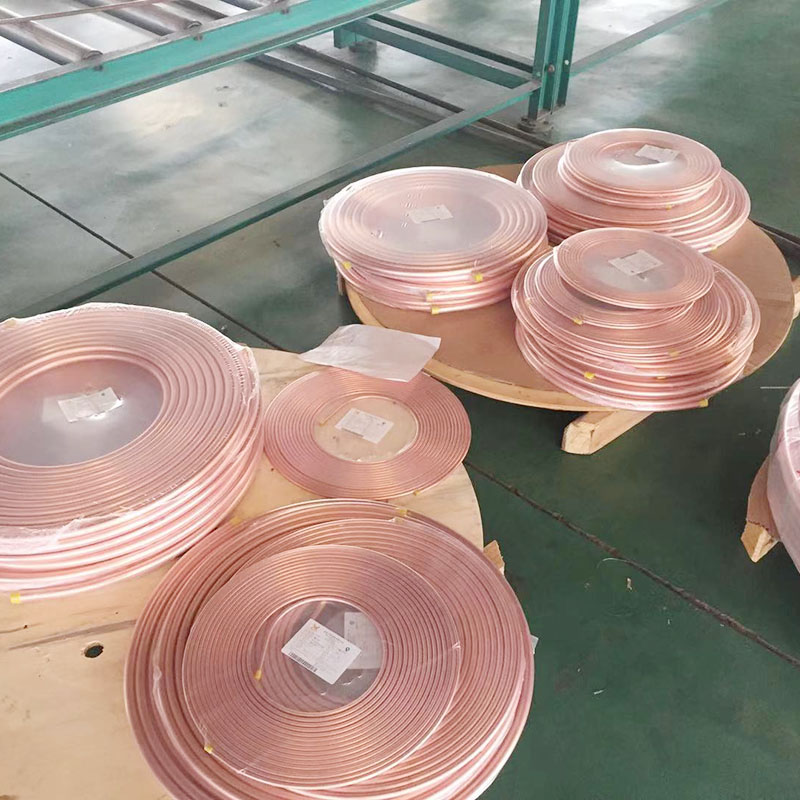
Level Wound Coils operate on entirely different mechanical principles. Manufacturers wind these continuous lengths symmetrically. The specific pattern closely resembles thread spooled tightly on a sewing bobbin. This structured winding technique creates massive, continuous material runs. These massive coils often weigh between 100kg and 300kg each, though some exceed this weight. They require distinct, specialized handling protocols but deliver absolutely unmatched scale for large operations.
The LWC copper pipe excels in the most demanding manufacturing environments. Consider these primary applications:
High-speed CNC hair-pin benders creating hundreds of evaporator and condenser coils per hour.
Continuous extrusion, bending, and automated cutting lines processing long runs of refrigeration copper pipe.
Large-scale OEM assembly plants demanding maximum machine utilization and minimal human touchpoints.
The yield advantage stands out as the single greatest benefit of this format. A single 130kg spool can easily run for several hours completely unassisted. You feed it into the automated system exactly once. The machinery processes hundreds of continuous meters without stopping. Consequently, you restrict your scrap to a single tail-end per shift. Compare this minimal waste to the dozens of scrap pieces generated by shorter discs over the same timeframe. This massive reduction in offcut waste completely transforms the financial economics of high-volume HVAC fabrication.
Decision-makers need a precise, objective evaluation framework. You must carefully align the physical traits of the tubing alongside the actual, verified capabilities of your shop floor. Ignoring facility readiness leads to expensive procurement mistakes.
Volume directly dictates your ideal format. Apply a simple, practical threshold logic here. You must compare the ongoing labor cost of continuous manual reloading against the capital efficiency of long automated runs. If your machine operators spend more than 15% of their daily shift swapping out material, short formats cost you far too much money. High run rates demand continuous feeds to keep your labor costs per unit strictly controlled.
Assess your facility readiness honestly before placing an order. Heavy bulk formats demand very specific capital investments. You absolutely need dedicated motorized payoff reels to uncoil the material safely without stretching it. Forklifts and heavy overhead lifting gear are mandatory requirements to move 300kg spools across the factory. Conversely, smaller flat formats require only basic manual racks and standard human labor. Do not upgrade your raw material format before upgrading your floor equipment.
Consider your available floor space and environmental controls carefully. Bulk spools demand highly stable, heavy-duty floor zones. You must also implement careful humidity control. These large units often ship containing wooden spools or cardboard cores highly vulnerable to moisture degradation. Meanwhile, smaller flat formats offer flexible, highly modular stacking options. You can fit them into much tighter spaces and standard industrial pallet racking systems.
Coil Format Comparison Summary Chart | ||
Operational Feature | Pancake Coil Characteristics | Level Wound Coil (LWC) Characteristics |
|---|---|---|
Typical Length & Weight | 15m to 50m (approx. 10kg to 20kg) | Continuous massive runs (100kg to 300kg+) |
Handling Gear Required | Manual lifting, basic unrolling racks | Forklifts, overhead cranes, motorized reels |
Automated Run Time | Very low (requires frequent stops) | Extremely high (hours uninterrupted) |
Scrap Generation Volume | High (many individual tail-ends wasted) | Low (only one tail-end per heavy spool) |
Adopting a new material delivery format introduces distinct operational risks. Real-world manufacturing experience highlights several critical friction points you must navigate carefully during the transition.
Tangling and deformation present serious, immediate challenges on the factory floor. If your payoff reel tension is not perfectly calibrated, heavy spools suffer from catastrophic cross-tangling. The layers bind tightly together as the machine pulls the material forward. This sudden tension spike can easily stretch, scratch, or flatten the HVAC copper tube. A severe tangle can ruin an entire production batch, damage the feeding mechanism, and halt the line entirely for hours while maintenance clears the jam.
Procurement hurdles also require strict attention. Mills enforce significantly higher Minimum Order Quantities (MOQs) for continuous spools compared to smaller formats. The continuous drawing and spooling process demands larger batch commitments to remain profitable for the supplier. You must plan for larger upfront capital outlays to secure these bulk deliveries. Small job shops often struggle to meet these strict MOQs without severely straining their operational cash flow.
Finally, you must evaluate transit damage vulnerabilities. Shipping mishaps affect formats very differently. A slightly dented small coil might lose a few outer meters of usable material. You simply cut off the bad section and use the rest manually. However, a dropped and severely deformed 300kg spool is often completely disastrous. If the spool flange breaks or the internal wire binds, the entire unit may jam your automated uncoiler. This single accident compromises a massive volume of expensive raw material instantly.
Closing the evaluation phase requires a structured, logical decision matrix. You must precisely match the format to your exact operational profile to avoid costly mistakes.
For job shops and field installers, stick primarily to the smaller, flat formats. This conservative approach helps maintain liquid cash flow by strictly avoiding bulk MOQs. You bypass heavy machinery capital expenditures entirely. It also ensures rapid deployment across diverse, temporary workstations. Agility and low overhead remain your biggest competitive advantages in the custom installation market.
For scaling OEMs, the transition to bulk spools becomes absolutely mandatory for survival. Make the switch immediately if your CNC equipment currently runs at greater than 60% utilization. You will need to invest in premium motorized uncoiling equipment. However, the return on investment is typically recouped within just a few months. You achieve this fast payback through drastic scrap reduction, improved labor utilization, and superior machine uptime.
Your actionable next step is highly straightforward. Audit your current monthly scrap tonnage specifically generated from short-coil offcuts. Quantify this wasted material accurately. Use this hard data to build a solid, irrefutable business case justifying the higher MOQs and equipment upgrades required for bulk spool integration.
The underlying thermal performance remains identical across both material formats. The raw material itself does not magically change. Therefore, you must treat this choice strictly as a manufacturing engineering and supply chain calculation.
Audit your current machinery downtime accurately to expose hidden labor and operational costs.
Ensure you possess the correct handling infrastructure before ordering heavy continuous spools.
Calculate your current scrap waste from tail-ends to justify future equipment investments.
Partner with suppliers capable of delivering consistent winding quality to prevent tangles.
We strongly recommend basing your final procurement decision on three distinct pillars. First, assess your facility's automation maturity. Second, evaluate your material handling infrastructure realistically. Finally, define your acceptable scrap thresholds. Upgrading your format at the exactly right time unlocks significant manufacturing efficiency and secures your long-term profitability.
A: Yes, you can use it, but it proves highly inefficient for automated setups. The short run times mean operators must stop the machine frequently to reload. These constant interruptions destroy productivity and increase the number of unusable tail-ends, severely inflating your overall scrap rates.
A: The difference is substantial due to the intended use case. Standard flat discs typically weigh between 10kg and 20kg, making them extremely easy to carry by hand. In contrast, bulk continuous spools usually range from 100kg to over 300kg, requiring forklifts and overhead cranes for safe maneuvering.
A: Yes, it strictly requires motorized tension-controlled payoff reels. Heavy spools carry immense physical momentum. Without automated tension management, the equipment will pull too hard or spool too loosely. Poor tension control risks necking, tangling, or completely flattening the tubing before it enters the machinery.
A: The core drawing processes remain identical at the mill level, meaning baseline consistency is the exact same. However, continuous spools maintain better roundness and structural integrity during automated unspooling, provided you handle them correctly with calibrated tension equipment. Poor handling compromises final dimensional tolerances.


